

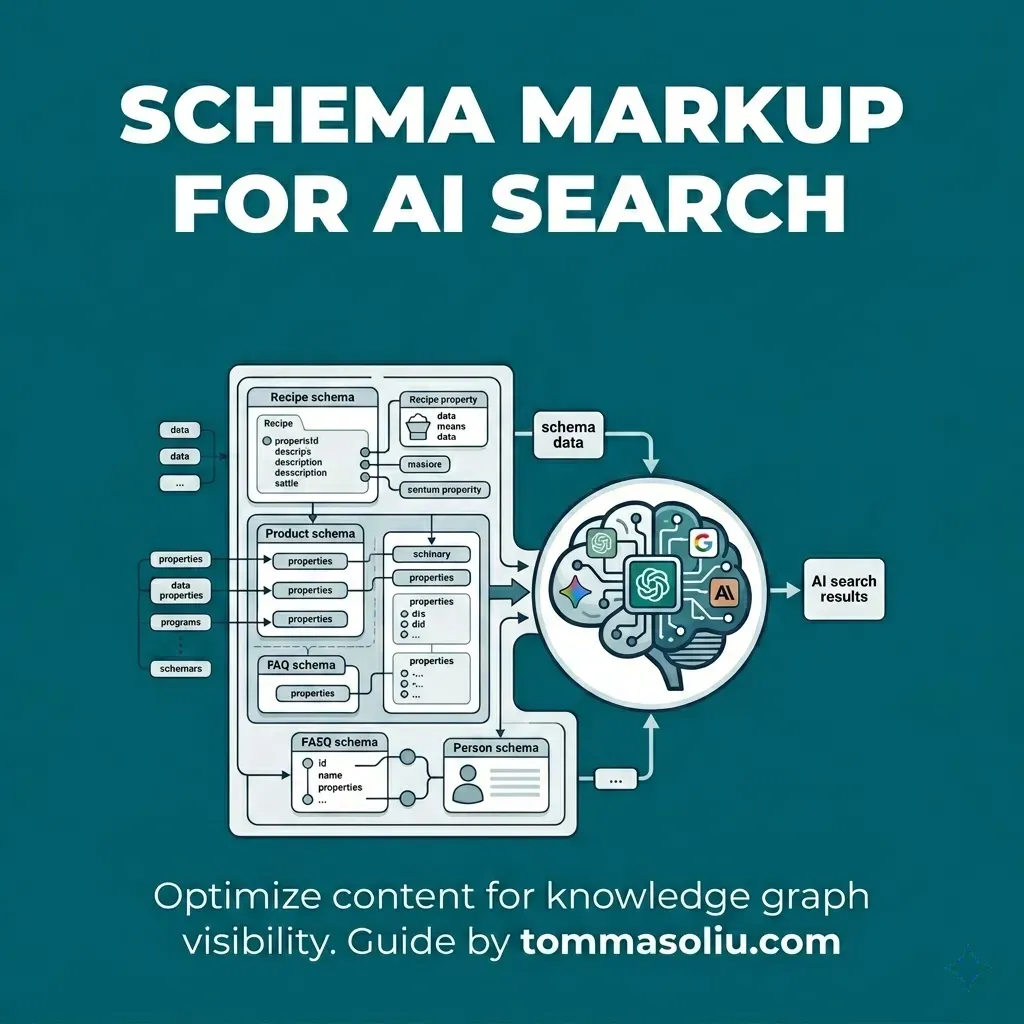
Key Takeaways
- Schema markup helps AI understand, extract, and reuse your content
- AI search selects answers, not just ranks pages
- Clear structure + schema = higher chance of being cited
- Article, FAQ, and HowTo are the most useful schema types
- Relevance matters more than using many schema types
- Schema improves visibility, not rankings directly
- Combine multiple schemas into one JSON-LD when possible
- Schema works best with strong internal linking and topical authority
What Is Schema Markup for AI Search
Schema markup is structured data added to your website.
It tells search engines and AI systems what your content actually means, not just what it says.
For AI search, this becomes critical.
AI tools don’t just index pages.
They extract answers, connect entities, and generate responses.
Schema reduces ambiguity and makes your content easier to use.
Why Schema Markup Matters for AI Search
AI search is shifting from ranking pages to selecting answers.
Schema helps your content become one of those answers.
Main advantages:
- Clear structure → easier parsing
- Better entity recognition → stronger authority
- Higher chance of being cited → more visibility
- Supports zero-click exposure → brand awareness without traffic
How AI Search Engines Use Schema Markup
- Parsing: AI identifies sections like FAQs, articles, and products more easily
- Entity mapping: Connects your brand, author, and topics into a clear graph
- Summarization: Extracts clean, structured answers
- Selection: Prioritizes sources that are easier to validate
Types of Schema Markup That Work Best for AI Search
You don’t need everything. You need coverage + relevance.
Full reference: https://schema.org
| Schema Type | When to Use / Why It Matters |
|---|---|
| Article | Blog posts, guides, SEO content |
| BlogPosting | More specific for blog content |
| FAQPage | Question-answer sections, AEO |
| HowTo | Step-by-step tutorials |
| Organization | Business identity and brand entity |
| Person | Author authority and credibility |
| Service | Service pages (SEO, consulting, etc.) |
| Product | Product pages (features, specs, price) |
| Review | Individual reviews |
| AggregateRating | Combined ratings |
| LocalBusiness | Local SEO, location data |
| BreadcrumbList | Navigation and structure clarity |
| WebPage | General page classification |
| VideoObject | Video content (YouTube, embeds) |
| ImageObject | Image metadata |
| Event | Webinars, launches, events |
More schema doesn’t mean better.
Correct schema applied correctly is what matters.
How to Add Schema Markup for AI Search (Step-by-Step)
- Identify the page type Understand if it’s a blog post, service page, or product page
- Choose the correct schema Match intent (Article, FAQ, HowTo, etc.)
- Generate the schema (JSON-LD) Use a generator or SEO plugin
- Add it to your page
Insert it in the
<head>or via your CMS/plugin - Test the implementation Validate with schema testing tools
- Monitor performance Track visibility and indexing over time.
Real Examples of Schema Markup for AI Search
Article Schema Example
<script type="application/ld+json">
{
  "@context": "https://schema.org",
  "@type": "Article",
  "headline": "Schema Markup for AI Search",
  "author": {
    "@type": "Person",
    "name": "Tommaso Liu"
  },
  "publisher": {
    "@type": "Organization",
    "name": "tommasoliu.com"
  },
  "datePublished": "2026-04-10"
}
</script>
FAQ Schema Example
<script type="application/ld+json">
{
  "@context": "https://schema.org",
  "@type": "FAQPage",
  "mainEntity": [{
    "@type": "Question",
    "name": "Does schema help AI search?",
    "acceptedAnswer": {
      "@type": "Answer",
      "text": "Schema helps AI understand and extract content more easily."
    }
  }]
}
</script>
HowTo Schema Example
<script type="application/ld+json">
{
  "@context": "https://schema.org",
  "@type": "HowTo",
  "name": "How to add schema markup",
  "step": [{
    "@type": "HowToStep",
    "text": "Choose the correct schema type for your page"
  }]
}
</script>
Common Mistakes to Avoid
- Using schema that doesn’t match the content
- Adding multiple conflicting schema types
- Forgetting required fields
- Creating schema without structured content
- Expecting direct ranking improvements
Best Practices for AI Search Optimization
- Keep schema aligned with search intent
- Use clean, readable content structures
- Add FAQs where they naturally fit
- Maintain consistent entity data (brand, author)
- Prioritize clarity over complexity
- If you use multiple schema types on the same page, combine them into a single JSON-LD script
How to Optimize Content in AI Search →
Advanced Tips (AEO / GEO Angle)
- Structure content for extraction (definitions, lists, steps)
- Use schema to reinforce meaning, not replace it
- Build clusters around key topics
- Strengthen internal linking between related entities
- Write content that can be quoted without context
Schema Markup in Practice (Use Cases)
| Business Type | Recommended Schema Markup |
|---|---|
| Local businesses | LocalBusiness + Organization + FAQ |
| SaaS | Product + Article + FAQ |
| Blogs / publishers | Article + FAQ + BreadcrumbList |
| E-commerce | Product + Review + AggregateRating |
Is Schema Markup Worth It for AI Search
- clear content structure
- strong topical authority
- consistent internal linking
Quick Checklist
- Am I using all relevant schema types for this page/business?
- Does each schema match the actual content?
- Is my JSON-LD implemented correctly?
- Did I validate with testing tools?
- Are required properties filled?
- Does visible content match the schema exactly?
- Am I avoiding duplicate/conflicting schemas?
- Is my brand/entity data consistent across pages?
- Is the page structure clear (headings, sections)?
- Did I re-check everything after publishing?
FAQs Schema markup for AI Search
Does schema improve AI rankings?
No direct ranking impact, but it improves selection and visibility.
Which schema is best for AI search?
Article and FAQ are the most broadly useful.
Is FAQ schema still useful?
Yes. It’s one of the easiest ways to structure extractable answers.
How long before results show?
Usually a few weeks, depending on crawling and indexing.
