

Search is changing.
For years, businesses focused mainly on SEO and Google rankings.
Now people also search through AI tools like ChatGPT, Gemini, and Perplexity, where answers are generated instead of showing only a list of websites.
This is where terms like SEO, AEO, and GEO start appearing.
They often sound confusing, but the practical differences are easier to understand than they seem.
In this guide, you’ll learn:
- the difference between GEO vs SEO
- where AEO fits between them
- what these changes mean for traffic and visibility
- how businesses and SEO specialists should adapt
By the way, I’m Tommaso Liu, I’ve been working in SEO since 2018, helping businesses grow through search visibility.
One of my clients grew from 13 to over 120 new patients per month after implementing a structured local SEO strategy.
If you’re curious about how that happened, you can see the full case study here.
What is GEO (Generative Engine Optimization)?
GEO stands for Generative Engine Optimization.
It refers to optimizing your content so it can appear inside answers generated by AI systems, not just in traditional search results.
Instead of showing a list of websites, AI tools generate a response by combining information from multiple sources.
Examples include:
- ChatGPT
- Google Gemini
- Perplexity
- AI Overviews in Google
In this environment, users often ask long questions instead of typing short keywords.
For example:
“What should I look for when choosing a dentist in Rome?”
The AI may produce a detailed answer and reference websites, businesses, or experts.
GEO focuses on making sure your content is clear, structured, and authoritative enough for AI systems to recognize and reference it.
What is SEO (Search Engine Optimization)?
SEO stands for Search Engine Optimization.
It focuses on improving your website so it ranks in traditional search engines like Google or Bing.
When someone searches for a service, search engines show a list of results. SEO helps your website appear among those results so users can visit your site.
Typical examples include searches like:
- dentist in Rome
- best running shoes
- local SEO services
SEO involves improving many aspects of a website, including content, structure, authority, and technical performance.
If you want a full beginner-friendly explanation, you can read my guide: SEO for beginners.
Even as AI search grows, SEO remains the foundation of online visibility, because most AI systems still rely heavily on information found on websites.
GEO vs SEO: overview of the main differences
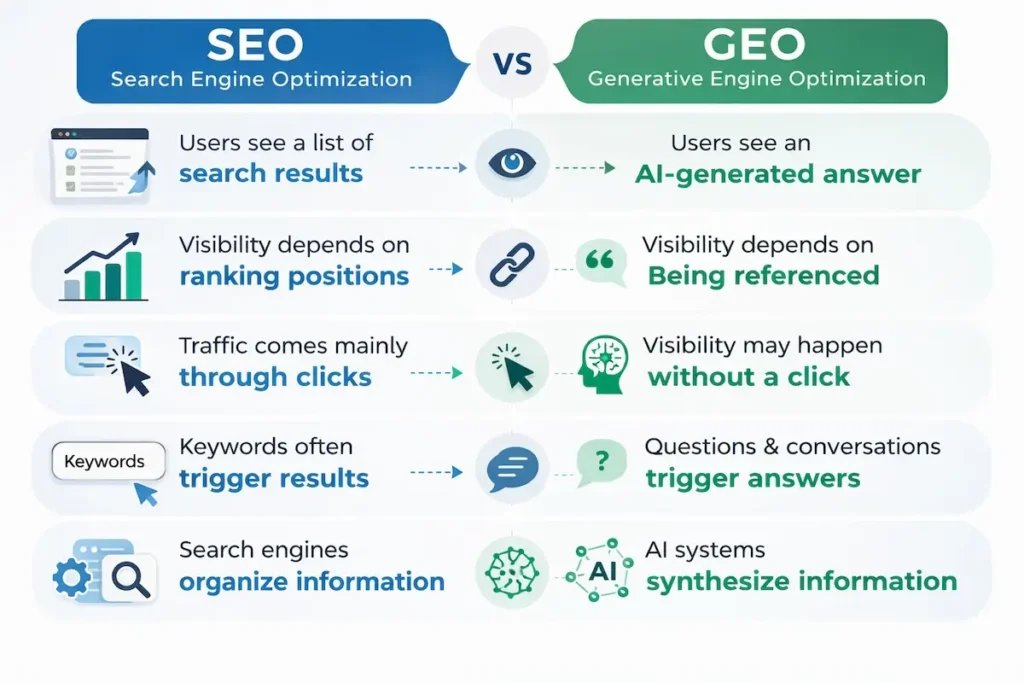
| SEO | GEO |
|---|---|
| Users see a list of search results | Users see an AI-generated answer |
| Visibility depends on ranking positions | Visibility depends on being referenced |
| Traffic comes mainly through clicks | Visibility may happen without a click |
| Keywords often trigger results | Questions and conversations trigger answers |
| Search engines organize information | AI systems synthesize information |
Understanding these differences helps businesses adapt their strategy without abandoning SEO entirely.
GEO vs SEO: rankings vs references
The most important difference between GEO vs SEO is how visibility works.
With SEO, success usually means ranking in the search results.
Users see a list of websites and decide which one to click.
With GEO, the visibility model changes.
AI systems generate a response and may reference sources inside the answer, sometimes without showing a list of results.
| SEO visibility | GEO visibility |
|---|---|
| Appearing in search engine results pages | Appearing inside AI-generated answers |
| Users choose which result to click | AI selects and references sources |
| Visibility depends on ranking positions | Visibility depends on authority and reliability signals |
| Traffic usually comes from clicks | Visibility may happen even without a click |
For businesses, this means visibility is no longer only about ranking higher than competitors.
It is also about becoming a trusted source that AI systems can reference when generating answers.
GEO vs SEO: clicks vs influence
SEO has traditionally been measured using direct performance metrics.
Things like traffic, rankings, and clicks show whether a page is attracting visitors from search engines.
These metrics still matter.
However, AI search introduces a slightly different dynamic.
| SEO performance focus | GEO visibility impact |
|---|---|
| Traffic to the website | Brand visibility inside AI answers |
| Click-through rate from search results | Being cited or referenced as a source |
| Rankings in search engines | Authority recognized by AI systems |
| Measurable visits and conversions | Influence that may happen before a click |
When an AI system references your brand or content, the user may not immediately visit your website.
But the business can still gain visibility and credibility.
The effect is similar to being quoted in an article or mentioned by an expert.
Even if the click happens later, the brand exposure and trust signals are already created.
GEO vs SEO: keywords vs questions
SEO strategies usually start with keyword research.
Businesses identify the words people type into search engines and optimize pages around those terms.
AI search changes the way queries are written.
Instead of short keyword phrases, users often ask longer questions in natural language.
| SEO search queries | GEO / AI search queries |
|---|---|
| Short keyword phrases | Full questions or conversations |
| Often 2–4 words | Often full sentences |
| Focused on specific terms | Focused on understanding a topic |
| Users refine searches step-by-step | Users ask one detailed question |
Examples of traditional searches:
dentist Rome
dental implants price
SEO services
Examples of AI-style searches:
“What should I check before choosing a dentist?”
“How do I know if dental implants are worth it?”
“Which SEO strategies work best for small businesses?”
Because of this shift, AI search favors clear explanations and content that answers real questions, not only pages optimized around short keywords.
GEO vs SEO: how information is structured
Search engines and AI systems process information differently.
Traditional search engines evaluate pages using signals like keywords, links, and page structure to determine rankings.
Generative AI systems instead try to understand, summarize, and combine information from multiple sources to produce an answer.
| SEO content structure | GEO content structure |
|---|---|
| Pages optimized around specific keywords | Content organized around topics and explanations |
| Information structured to rank in search results | Information structured to be understood and summarized |
| Focus on ranking signals and page relevance | Focus on clarity, context, and expertise |
| Users navigate between multiple pages | AI synthesizes information into one response |
Because of this, content that is clear, well-organized, and easy to interpret is more likely to be used by AI systems.
This is why detailed guides, explanations, and logically structured content often appear as sources in AI-generated answers.
GEO vs SEO: search engines vs generative engines
Another important difference between GEO vs SEO is the technology that produces the results.
Traditional search engines rank pages using algorithms that evaluate relevance and authority.
Generative engines use AI models that analyze information from multiple sources and generate a response.
| SEO environment | GEO environment |
|---|---|
| Search engines rank individual pages | AI models generate complete answers |
| Results appear as a list of links | Responses appear as a synthesized explanation |
| Algorithms evaluate relevance and authority | AI systems combine information from multiple sources |
| Users choose which result to open | Users often receive the answer immediately |
In traditional search, users explore several websites to find the information they need.
In AI search, the system attempts to deliver the answer directly.
This changes how people interact with information and how businesses gain visibility online.
What businesses should do differently
Businesses that already invest in SEO do not need to start from zero.
Most of the fundamentals still apply.
However, the focus shifts slightly.
Instead of optimizing only for rankings, businesses should also think about clarity, expertise, and information quality.
Some practical adjustments include:
- writing content that clearly explains topics and decisions
- structuring pages so information is easy to understand
- demonstrating expertise and credibility
- covering questions users commonly ask before making decisions
The goal is not only to rank pages, but to make your website a trusted source of information that both search engines and AI systems can reference.
In practice, this means strong SEO foundations still matter, but content must also be clear enough for AI systems to interpret and summarize.
Final thoughts
The difference between GEO vs SEO may sound technical, but the practical takeaway is simple.
SEO focuses on helping your website rank in search engines.
GEO focuses on helping your expertise and content be recognized by AI systems.
Both aim to achieve the same outcome: making your business visible when people look for information, services, or solutions.
For most businesses and SEO specialists, the goal is not to replace SEO with GEO.
Instead, it is to build strong SEO foundations while creating clear, trustworthy content that AI systems can understand and reference.
Search technology is evolving, but the fundamentals remain the same: useful information, clear explanations, and real expertise tend to perform well across both traditional search and AI-driven discovery.
My Case Study: 13 to 81 New Patients per Month
This clinic was nearly invisible online — averaging 13 new patients per month.
By fixing website structure, optimizing Google Business Profile, and applying consistent weekly SEO, growth became steady and predictable.
Within months, they reached 81 new patients per month, roughly tripling revenue.
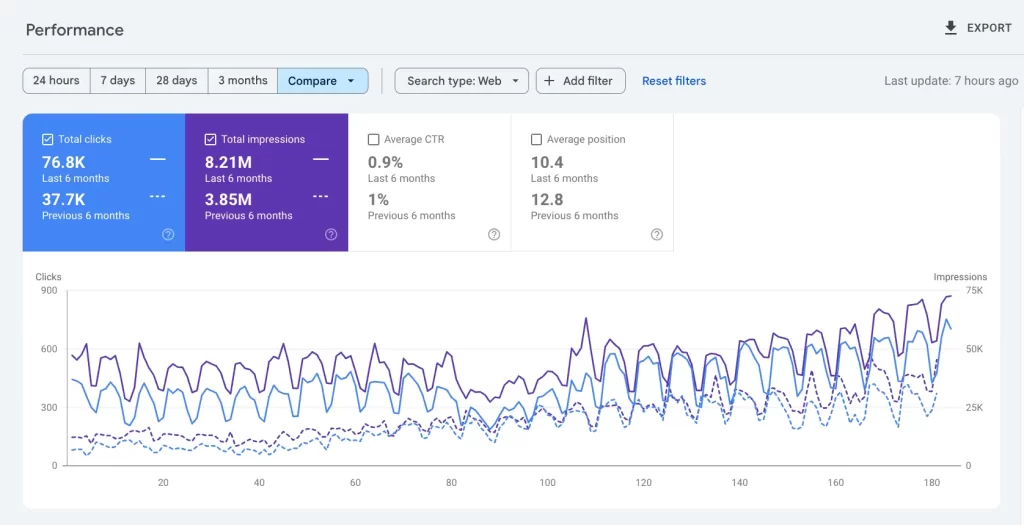
Search Console shows the compounding effect:
37.7K clicks → 76.8K clicks in 6 months
No hacks. Just structured dental SEO done consistently — and built to convert.

FAQs about GEO vs SEO
Is GEO replacing SEO?
No.
SEO remains the foundation of online visibility. AI systems still rely heavily on information from websites. GEO simply expands how that information is used.
Do businesses need a separate GEO strategy?
Not necessarily.
Many of the same principles used in SEO also support GEO visibility. Clear content, structured information, and expertise signals tend to work well across both environments.
Will AI search reduce website traffic?
In some cases, yes.
AI systems sometimes answer questions directly without requiring users to visit a website. However, businesses that become recognized sources can still benefit through brand visibility and trust.
What types of businesses benefit most from GEO?
Businesses that rely on expertise and research tend to benefit the most.
Examples include healthcare providers, consultants, agencies, educational platforms, and professional services.
These industries often depend on trust and detailed explanations, which AI systems frequently reference.
Should small businesses care about GEO yet?
Yes, but they should not ignore SEO.
For most small businesses, the priority should still be strong search visibility. GEO becomes more important as AI search continues expanding, especially for businesses publishing useful content and expertise online.
