

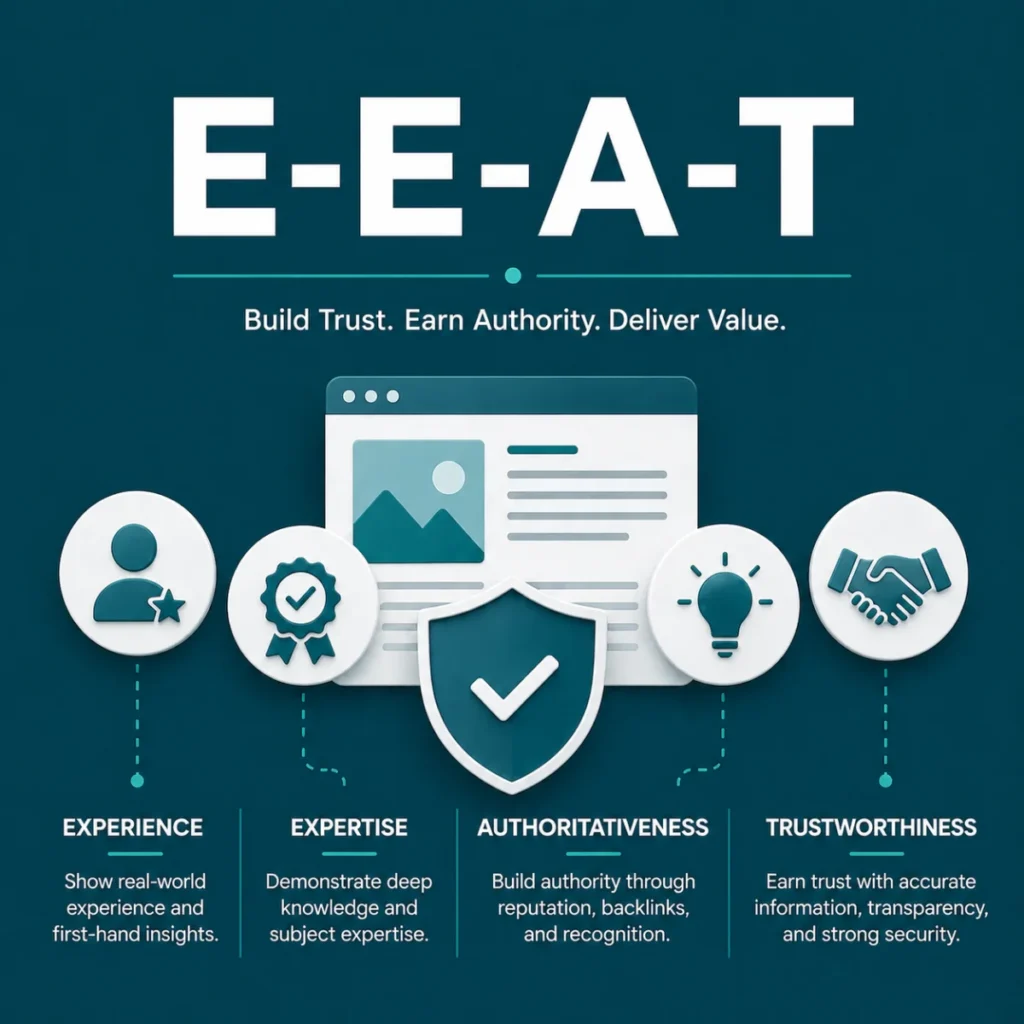
What is E-E-A-T in Google Search
Google introduced E-E-A-T (Experience, Expertise, Authoritativeness, Trustworthiness) in its Search Quality Rater Guidelines as the standard for evaluating page and site quality. The four signals work together, not in isolation. A page can show deep expertise but still fail on Trust, which Google treats as the most critical of the four.
Experience
Experience refers to first-hand, real-world involvement with the topic being covered.
Google distinguishes between someone who has personally done something and someone who has simply researched it. A dentist writing about tooth extractions demonstrates experience. A copywriter summarizing Wikipedia does not.
Example: A travel blog reviewing a hotel after a real stay signals experience. A post compiled from other reviews does not, even if the writing quality is identical.
Expertise
Expertise is demonstrated knowledge and skill in a subject area.
This can come from formal credentials (a surgeon writing about surgery) or from proven depth of knowledge (a self-taught developer with a decade of published technical writing). Google evaluates expertise at both the author level and the content level.
Example: An article about tax deductions written by a certified accountant signals expertise. The same article written by a general lifestyle blogger does not, even with identical information.
Authoritativeness
Authoritativeness is your reputation within your field, as recognized by others.
It is not self-declared. It is built through backlinks from credible sites, citations in industry publications, mentions by recognized experts, and a consistent publishing track record on one topic area.
Example: An SEO article linked to by Ahrefs or Semrush carries more authoritativeness than one published in isolation, regardless of content quality.
Trustworthiness
Trustworthiness is the overarching signal Google weights most heavily among the four.
It covers accuracy, transparency, site security (HTTPS), clear authorship, honest business information, and absence of deceptive practices. A site can demonstrate experience, expertise, and authority, and still lose ranking ground if trust signals are missing or broken.
Example: A medical site with no author bio, no privacy policy, and no contact page will score low on Trust, regardless of how well-written the content is.
E-E-A-T vs E-A-T: What Changed and Why
Google added the first E, Experience, to its guidelines in December 2022. Before that, the framework was simply E-A-T (Expertise, Authoritativeness, Trustworthiness).
| E-A-T (before 2022) | E-E-A-T (from December 2022) |
|---|---|
| Expertise, Authoritativeness, Trustworthiness | Experience, Expertise, Authoritativeness, Trustworthiness |
| Focused on credentials and knowledge | Adds first-hand, lived experience as a distinct signal |
| A qualified author was sufficient | Direct involvement with the topic is now evaluated |
| Product reviews could be written from specs | Product reviews now require evidence of actual use |
| Expertise could be inferred from credentials | Experience must be demonstrated inside the content |
The practical implication: content that reads like a well-researched summary no longer clears the same bar it once did. Google now expects proof that the author has been there, used it, or lived it.
How Google Uses E-E-A-T to Rank Content
E-E-A-T is not a score Google calculates and feeds directly into its algorithm. It is a framework human quality raters use to evaluate pages, and those evaluations train the machine learning systems that do influence rankings.
The process works in this sequence:
- Google crawls and indexes the page
- Quality raters assess the page against E-E-A-T criteria using the Search Quality Rater Guidelines
- Their ratings feed into training data for Google’s core ranking systems
- Google’s algorithm applies those learned signals at scale across billions of pages
- Pages that consistently demonstrate strong E-E-A-T signals rank higher over time
E-E-A-T is not a one-time check. Google reassesses quality signals continuously, which is why a single well-written article rarely moves rankings on its own. The pattern across the entire site matters.
How to Improve E-E-A-T: Step-by-Step
Improving E-E-A-T means giving Google more evidence, across more signals, consistently over time. The steps below follow the order that produces the fastest compounding effect: fix the foundation before building authority on top of it.
1. Audit Your Current E-E-A-T Signals
Before making changes, map what you currently have and what is missing.
- Do your authors have visible bios with credentials or relevant experience?
- Does every page with health, legal, or financial information name a qualified author?
- Is your site on HTTPS with a working privacy policy and contact page?
- Do you have backlinks from recognized sources in your industry?
- Does your content include first-hand examples, case studies, or original data?
Any gap in this list is a concrete improvement target, not a vague signal. Start here before publishing new content.
2. Build Credible Author Profiles
Every article needs a named author with a visible bio that establishes why they are qualified to write it.
The bio should reference specific experience, credentials, or professional history. A generic “content team” byline contributes nothing to E-E-A-T. Link the author bio to a LinkedIn profile or personal site to create an external, verifiable entity Google can cross-reference.
Example: An article about implant dentistry should be authored by a dentist, or co-authored with clinical review attribution. The byline “Staff Writer” signals no expertise and no experience.
3. Demonstrate First-Hand Experience in Content
Experience must be visible inside the content itself, not just claimed in the author bio.
This means including original observations, real results, specific dates, personal outcomes, or documented case examples. Statements like “in our experience” or “based on our client results” are weak unless supported by specifics.
Example: Instead of writing “SEO can increase organic traffic,” write “a dental practice we worked with in Rome grew from 13 to 120+ new patients per month after 12 months of structured local SEO, content, and Google Maps optimization.” That is a verifiable, experience-backed claim.
4. Earn Authoritative Backlinks and Brand Mentions
Authority is built externally. Google measures it by looking at who links to you and who mentions you in trusted contexts.
Tactics that build authoritativeness:
- Publish original research, statistics, or data others will cite
- Contribute guest articles to recognized publications in your niche
- Get listed in industry directories, roundups, and comparison pages
- Build relationships with journalists covering your sector (HARO, Qwoted, or equivalent)
- Earn unlinked brand mentions on high-authority sites, which Google also processes as trust signals
5. Strengthen Site-Wide Trustworthiness
Trust operates at the site level, not just the page level. A single high-quality article on an otherwise thin or opaque site will not rank well.
Site-wide trust checklist:
- HTTPS across every page
- Privacy policy, terms of service, and contact page visible in the footer
- Physical address and phone number for local or service businesses
- Verified Google Business Profile where applicable
- Schema markup for Organization, Author, and LocalBusiness entities
- No broken links, no thin pages, no content with unverifiable claims
6. Optimize for AI Search Visibility
Strong E-E-A-T is also the primary requirement for being cited by ChatGPT, Perplexity, and Google’s AI Overviews (AIO).
AI systems pull from the same trust and authority signals Google uses for organic ranking. A page that ranks well in Google for a topic is statistically more likely to be cited in AI-generated answers on that same topic.
Practical steps for AI visibility:
- Structure content with clear, direct answers under each heading
- Use FAQ sections with complete, standalone answers
- Add structured data (Schema) for FAQPage, HowTo, and Article types
- Publish content that answers the specific questions AI tools receive in your niche
- Build entity associations so AI systems can place your brand in a clear topical context
How to Optimize Content for AI Search →
YMYL Pages and E-E-A-T: Higher Standards
YMYL (Your Money or Your Life) is Google’s classification for content that could significantly affect a person’s health, finances, safety, or legal situation. Google applies E-E-A-T standards more strictly to YMYL pages than to any other content type.
| YMYL category | Examples |
|---|---|
| Health and medical | Symptoms, treatments, medications, dental procedures |
| Financial | Investments, tax advice, insurance, loans |
| Legal | Contracts, rights, regulations, legal processes |
| Safety | Emergency procedures, product safety warnings |
| News and current events | Coverage of events affecting public decisions |
If your site operates in any of these categories, E-E-A-T is not optional. A dental practice publishing content about implants, periodontal disease, or sedation without qualified authorship and clinical accuracy signals is directly penalized in Google’s quality assessment. The bar is higher, and the consequence of failing it is proportionally larger.
E-E-A-T and AI Search: ChatGPT, Perplexity, and Google AIO
As noted in the improvement steps above, E-E-A-T is the connective tissue between Google rankings and AI search citations. The two are not separate systems requiring separate strategies.
ChatGPT, Perplexity, and Google’s AI Overviews (AIO) all rely on web content as a primary source. They are more likely to cite pages that:
- Rank in the top positions on Google for their topic
- Come from domains with established topical authority
- Contain clear, structured, directly answerable content
- Are authored by identifiable, credible entities
The practical consequence: a business that neglects E-E-A-T loses visibility on Google and simultaneously reduces its chances of appearing in AI-generated answers. These are no longer separate risks.
A dental practice with strong E-E-A-T, consistent local SEO, and structured content about its services can be cited by ChatGPT when a patient asks “which dentist in Rome specializes in implants?” This is already happening. The difference between the practices that get cited and those that do not is, in most cases, the quality and consistency of their E-E-A-T signals.
Frequently Asked Questions about E-E-A-T
Does E-E-A-T affect all content types equally?
No. Google applies stricter E-E-A-T standards to YMYL content (health, finance, legal, safety) than to general informational content. A blog about travel destinations faces less scrutiny than one about medication dosages. The higher the potential impact on a reader’s life, the more Google demands verifiable expertise and trust signals.
Can AI-generated content have strong E-E-A-T?
AI-generated content can pass E-E-A-T standards only when it is reviewed, edited, and published under a named author who is genuinely qualified on the topic. The content itself must still contain accurate, experience-backed information. Google’s guidance is clear: it evaluates the quality of the content and the credibility of its source, not the tool used to produce it.
Does E-E-A-T apply differently to small business websites?
The signals are the same, but the starting point differs. A small business does not need national press coverage to demonstrate authoritativeness. Local citations, Google Business Profile verification, consistent NAP (Name, Address, Phone) data, and genuine customer reviews all contribute meaningfully. Local E-E-A-T is built through depth in a defined geographic and topical area.
Is a Google penalty possible for low E-E-A-T?
Google does not issue manual penalties specifically labelled as “low E-E-A-T.” However, core algorithm updates, particularly the Helpful Content system and core updates, consistently reduce rankings for sites that score poorly on quality rater assessments. The effect is the same as a penalty: significant ranking drops that recover slowly, and only after genuine improvements are made.
Does E-E-A-T help with Perplexity and ChatGPT citations?
Yes. As covered earlier, AI systems use overlapping trust and authority signals to select sources. A page with strong E-E-A-T that ranks well on Google is significantly more likely to be cited in Perplexity answers and referenced in ChatGPT responses on the same topic. Improving E-E-A-T improves visibility across both traditional and AI search simultaneously.
