
Dental SEO in 2026 is no longer just adding keywords to a website.
It means structuring your entire online presence so your practice is easy to find, easy to trust, and easy to choose.
Patients now search on Google, Maps, YouTube, and even AI tools before they call. If your dental SEO is weak, you depend on ads. If it’s strong, you build steady patient flow without chasing every click.
In this guide, you’ll learn how dental SEO works in 2026, what it costs, and how to rank locally while turning traffic into real booked appointments — not just impressions.
P.S. Want to see this working in a real clinic?
Dental SEO is the process of optimizing a dental practice’s online presence to attract patients from organic search results.
It focuses on helping your clinic appear when someone searches for treatments like “dental implants near me” or “emergency dentist.”
At its core, dental SEO combines three elements:
The goal is simple: show up at the exact moment a patient is looking for a dentist — and make your practice the obvious choice.
Dental SEO captures patients at the exact moment they are actively researching treatment and comparing providers.
The data strongly suggests how closely search visibility connects to real appointment activity:
Source: Sixth City Marketing
Dental SEO in 2026 depends on strengthening four key areas of your online presence.
If these are strong, visibility improves. If one is weak, performance suffers.
Focus on:
Dental SEO works when these areas align.
It’s not about adding more tactics — it’s about strengthening the right parts of your online presence.
Dental SEO and Google Ads both attract patients — but they work very differently.
SEO builds long-term visibility in organic search and Google Maps.
Google Ads generates immediate traffic through paid placements.
Here’s a simple comparison:
| Dental SEO | Google Ads |
|---|---|
| Builds long-term organic visibility | Delivers immediate paid visibility |
| Traffic continues without paying per click | Traffic stops when ads stop |
| Stronger for trust and authority over time | Strong for fast testing and promotions |
| Lower cost per patient long term | Higher cost per patient over time |
| Takes months to build momentum | Can generate leads within days |
Most growing practices use both.
Ads can generate short-term leads.
SEO builds predictable patient flow over time.
Want to see how SEO performed compared to paid traffic in a real clinic?
Dental SEO is not instant, but it builds momentum over time.
Most practices see progress in phases:
Speed depends on competition, city size, content depth, and authority signals.
SEO compounds.
The longer it’s built correctly, the more predictable and stable patient flow becomes.
And here’s real case study proof.
| Situation | Better Alternative & Why |
|---|---|
| You need patients immediately (next 2–4 weeks) | Google Ads: Delivers instant visibility for high-intent searches while SEO builds in the background |
| Brand-new practice with no basic website | Website + Local Setup First: Build minimum structure before investing in SEO growth |
| Promoting a short-term offer or promotion | Paid Ads / Social Campaigns: Faster traction for time-sensitive campaigns |
| Very low marketing budget and no consistency | Referral & Review Strategy: Focus on word-of-mouth and local reviews before scaling SEO |
| Expanding into a new city quickly | Local Ads + Temporary Landing Pages: Gain quick exposure before organic rankings develop |
Dental SEO is rarely the wrong channel — but timing and priorities matter.
Dental SEO in 2026 follows a priority sequence, not random tactics.
Use this high-level roadmap:
Each stage increases leverage.
Foundations create stability.
Local optimization creates early traction.
Content and authority compound long term.
Dental SEO works best when built as a system — not as isolated improvements.
If you are starting from zero, you can skip to building foundations.
But if you already have a website, blog content, or have invested in SEO without clear results, it is time for an audit — ideally an external, professional review.
An audit should examine:
The goal is to reveal your main issue, whether it’s structure, authority, technical setup, local optimization, or strategy — so you can prioritize the right next move.
Dental SEO should start with strategy — not content creation.
Before building pages, you need to identify which treatments and searches offer the best opportunities.
Start by:
The goal is not to rank for everything.
It is to dominate the right opportunities first.
| Source of Ideas | Examples (U.S. Market) |
|---|---|
| Brainstorm from your experience | dental implants, porcelain veneers, Invisalign treatment, emergency dentist |
| Competitors you know or discover in the tool | best dentist Dallas, cosmetic dentist Chicago |
| Relevant / adjacent keywords suggested by SEO tool | implant dentist cost, clear aligners price, tooth extraction recovery |
| Local variations | dental implants New York, Invisalign Los Angeles |
| Question-based searches | dental implant cost, Invisalign pain level |
The best keywords to prioritize are those with strong search volume and the lowest realistic ranking difficulty — meaning they attract demand, but are still achievable for your practice.
Before publishing content, your website must be properly set up.
This means putting the technical and identity basics in place so future pages actually carry weight.
Set up:
This phase is not about volume.
It is about creating a stable base so every new page, blog post, or local signal builds on something solid — not on guesswork.
Once your infrastructure is stable, local visibility becomes a priority.
Dental SEO depends heavily on appearing in Google Maps and local search results — especially for treatment-specific and “near me” searches.
This phase focuses on strengthening:
Local signals often generate the fastest visible improvements.
When properly aligned with your website, they turn search demand into real appointment opportunities.
Once your structure, tracking, and local setup are in place, it’s time to build the assets that drive growth.
This phase focuses on publishing the pages that matter most:
The priority is not volume.
It is building strong, interconnected pages around your highest-opportunity keywords.
When core pages and supporting content reinforce each other, rankings become more stable — and traffic becomes more qualified.
After your core pages and blog structure are live, growth comes from amplification — not constant reinvention.
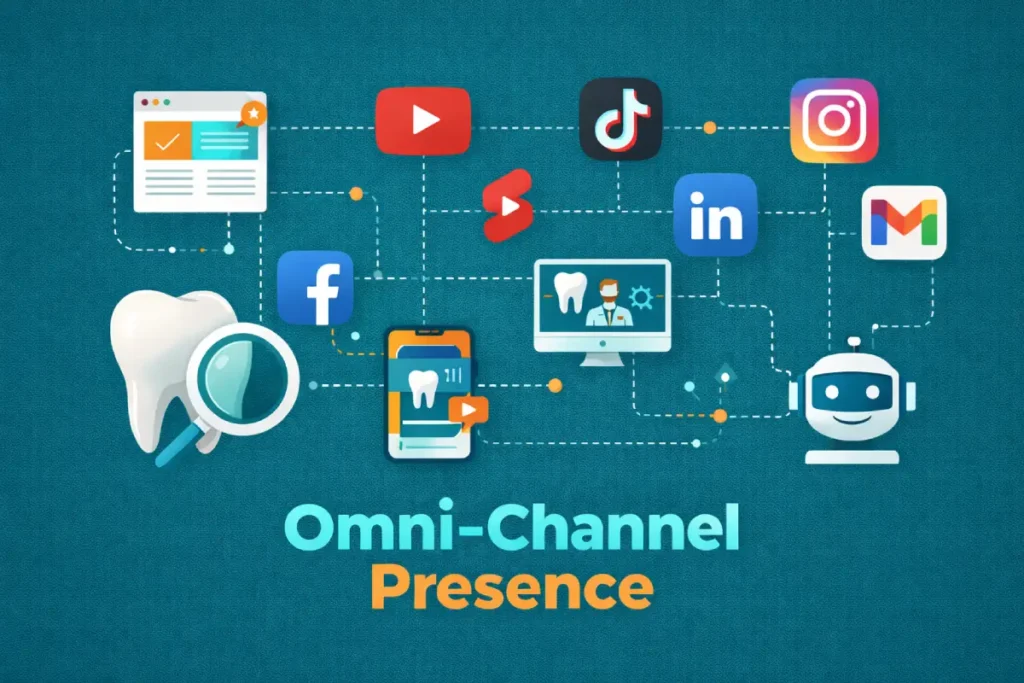
This phase focuses on distributing your expertise across multiple channels:
The goal is consistency.
When your expertise appears across platforms — website, social, Maps, email — authority compounds, brand recognition increases, and dental SEO becomes stronger over time.
| Mistake | Why It Hurts Performance |
|---|---|
| Thin or generic service pages | Hard to rank and weak at converting patients |
| No clear keyword strategy | Leads to scattered content with no authority |
| Keyword cannibalization (multiple pages targeting the same term) | Pages compete against each other and weaken rankings |
| Ignoring Google Business Profile optimization | Misses high-intent “near me” searches |
| Inconsistent NAP (name, address, phone) details | Confuses search engines and weakens local trust |
| No visible doctor bio or credentials | Reduces authority and E-E-A-T signals |
| Publishing blog posts without internal linking | Pages don’t reinforce each other |
| Slow or non-mobile-friendly website | Hurts rankings and user experience |
| Not collecting or responding to reviews | Weakens local ranking and credibility |
| Misalignment between website and local listings | Sends mixed signals about your services |
| Situation | Why It May Be Time for Professional Support |
|---|---|
| You don’t have the knowledge, time, or team to manage SEO in-house | SEO requires ongoing coordination across structure, content, local signals, and technical setup — not occasional updates |
| You or your team are “figuring it out” through trial and error | Bloated blogs, thin pages, cannibalization, and technical errors accumulate and become expensive to fix later |
| You want steady, long-term new patient growth — not seasonal word of mouth or expensive hit-or-miss ad bursts | A structured SEO strategy builds predictable visibility over time, especially if you’re willing to invest patiently instead of chasing quick spikes |
| You tried before with a smaller agency and got burned | A poor execution doesn’t mean SEO doesn’t work — it may simply mean the strategy or partner was misaligned |
Most clinics don’t struggle because SEO is ineffective.
They struggle because it’s under-structured or inconsistently executed.
Now, this is the part where I’m supposed to say “hire me.”
But instead, you can judge the work first.
Dental SEO should begin with identifying the most valuable treatment keywords based on search volume, competition, and revenue potential.
This includes selecting realistic opportunities, mapping them into core pages and supporting content, and building a structured growth plan instead of targeting random terms.
Each primary treatment (implants, Invisalign, veneers, emergency care, etc.) should have a dedicated, well-structured page.
Optimization includes clear headings, strong content depth, internal linking, and alignment with user search intent.
Supporting articles should build depth around each main treatment.
This helps search engines understand your expertise and improves ranking stability over time.
Your website must be fast, mobile-friendly, properly indexed, and structured correctly.
Technical issues like crawl errors, poor architecture, or missing schema can silently limit growth.
Local visibility depends on accurate business information, optimized categories, reviews, and alignment between your website and Maps presence.
Doctor bios, credentials, authorship clarity, and consistent identity across platforms help strengthen E-E-A-T signals and patient trust.
SEO requires monitoring rankings, traffic, and conversions.
Strategy should evolve based on data and competition — not guesswork.
Dental SEO investment depends on how comprehensive and strategic the approach is.
In the U.S. market, realistic ranges look like this:
Most established practices aiming for predictable growth invest in the $1,500–$3,000/month range, where strategy, structure, and authority are built together — not treated as isolated tasks.
SEO works at every level. The difference is speed, stability, and competitive strength.
Be careful with “We guarantee #1 rankings.”
Often, they don’t clearly say **for which keywords**.
Ranking #1 for something very specific like “emergency dentist north side” might be easy — because few people search for it.
But promising #1 for “dentist New York” is not realistic.
A serious provider explains what’s possible and what’s competitive.
Absolute guarantees usually don’t.
If an agency focuses on only one slice — blog writing, technical SEO, or backlinks — results will be limited.
Dental SEO works when key areas move together (Local SEO, technical SEO, keyword research, data tracking, performance optimizazion, etc.)
It’s like dentistry.
A dentist who only does fillings is different from one who handles surgery, implants, and full treatment plans.
Integration makes the difference.
SEO is rarely a one-time intervention (I learned with experience and failures).
An initial setup can help, but sustainable rankings usually require ongoing refinement and expansion.
Publishing a few pages and stopping is like investing once and expecting compound returns without reinvesting.
SEO compounds — but only if it continues.
If the entire pitch revolves around “we’ll build backlinks because you only need this,” be cautious.
Buying or forcing links without strong service pages, content depth, local signals, and authority is like asking random strangers to recommend your clinic before your treatments and reputation are solid.
Backlinks amplify substance.
They cannot replace it.
Without structure and content, links are noise.
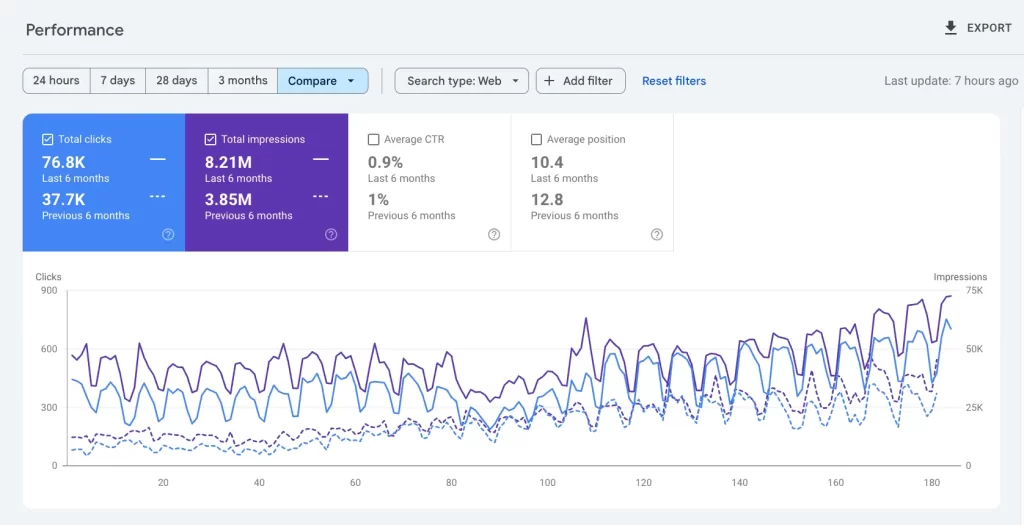
This clinic was nearly invisible online — averaging 13 new patients per month.
By fixing website structure, optimizing Google Business Profile, and applying consistent weekly SEO, growth became steady and predictable.
Within months, they reached 81 new patients per month, roughly tripling revenue.
Search Console shows the compounding effect:
37.7K clicks → 76.8K clicks in 6 months
No hacks. Just structured dental SEO done consistently — and built to convert.

Yes — especially for small practices.
Smaller clinics often compete locally, not nationally. That means the right structure, local optimization, and consistent content can produce meaningful visibility without massive budgets.
Dental SEO helps small practices:
The key is focus.
Instead of trying to rank for everything, small practices can prioritize a few high-value treatments and build depth around them.
When done correctly, dental SEO becomes a steady source of new patient inquiries — not a short-term marketing experiment.
Your website should not stay static.
Core treatment pages should be reviewed at least once or twice per year to ensure information is accurate, complete, and aligned with current search demand.
Blog content can be updated when:
You don’t need constant redesigns.
But small, strategic updates — improving content depth, adding FAQs, refining internal links — help maintain and strengthen rankings over time.
SEO rewards consistency and relevance, not one-time effort.
Dental SEO is a specialized form of SEO focused on attracting local patients for specific treatments.
Traditional SEO can target national or global audiences.
Dental SEO focuses on local intent, trust, and treatment-based searches.
Here’s a simple comparison:
| Dental SEO | Traditional SEO |
|---|---|
| Targets local patients | Can target national or global audiences |
| Focuses on treatments (implants, Invisalign, emergency) | Often focuses on products, SaaS, or general topics |
| Strong emphasis on Google Maps & reviews | Less dependent on local listings |
| Relies heavily on doctor authority & credentials | Authority often based on brand or backlinks |
| Converts high-intent searches into appointments | Converts traffic into leads or sales |
Dental SEO is more location-driven, trust-based, and treatment-specific.
It is less about traffic volume — and more about attracting the right patients.
Yes — dental SEO is still relevant.
AI tools like ChatGPT, Gemini, and Google AI results still rely on high-quality online content. They pull information from websites that rank well, are well-structured, and demonstrate expertise.
Ranking high and publishing strong content remains fundamental.
What’s changing is user behavior.
In the past, someone researching Invisalign or teeth whitening might read your article and then book an appointment.
Now, they may get the answer directly inside an AI result and never visit your site.
That means dental SEO is still essential — but visibility, authority, and brand recognition matter even more than just clicks.
