

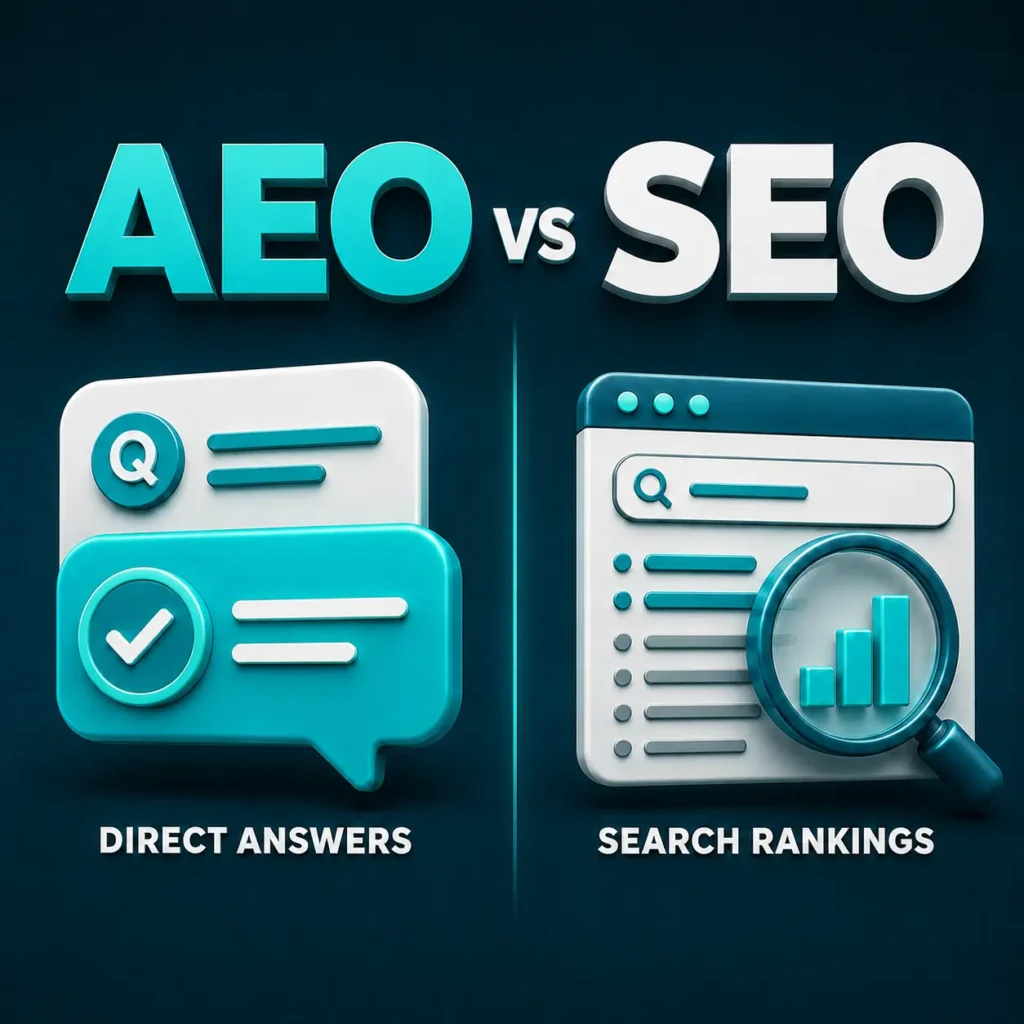
What is Answer Engine Optimization (AEO)
Answer Engine Optimization (AEO) is the practice of optimizing content so it gets picked up, understood, and surfaced as a direct answer by “answer engines,” systems that give users a response instead of a list of links.
This includes voice assistants (Siri, Alexa, Google Assistant), featured snippets, Google’s AI Overviews, and increasingly the answer boxes inside tools like ChatGPT, Perplexity, and Gemini.
It overlaps heavily with GEO (Generative Engine Optimization), but there’s a useful distinction.
AEO vs GEO
- AEO is about structuring content to be extracted as a direct answer to a specific question, think featured snippets, “People Also Ask” boxes, voice search results. It’s older and more tied to traditional search infrastructure.
- GEO is broader, about how your content gets synthesized, summarized, and cited by generative AI systems across a whole conversation or research task, not just a single answer box.
In practice, the two disciplines share most of the same tactics:
- Answer-first formatting: leading a section with the direct answer in the first sentence or two, then supporting detail after
- Clear entity definition: making sure the “who/what” of your content is unambiguous to a machine parsing it
- Structured data / schema markup: FAQ schema, HowTo schema, etc., that helps engines extract structured answers
- Question-based headings: matching the phrasing of how people actually ask (H2/H3s framed as questions)
- Concise, factual, well-sourced claims: answer engines favor content that’s citable and verifiable over fluffy or vague copy
What is Search Engine Optimization (SEO)
Search Engine Optimization (SEO) is the practice of improving a website so it ranks higher in organic (unpaid) search results on engines like Google and Bing, driving more relevant traffic without paying for ads.
It generally breaks down into a few core pillars:
- Technical SEO: making sure a site can be crawled and indexed properly, fast page speed, mobile-friendliness, clean site architecture, no broken links or redirect chains, proper schema markup
- On-page SEO: optimizing individual pages, title tags, meta descriptions, headings, keyword usage, internal linking, content quality and relevance to search intent
- Off-page SEO: signals from outside the site itself, mainly backlinks from other authoritative sites, but also brand mentions, reviews, and citations
- Content SEO: creating content that actually matches what people are searching for and satisfies their intent, whether that’s informational, transactional, navigational, or commercial
The underlying goal is always the same: help search engines understand what a page is about and why it deserves to rank, while giving users a genuinely useful experience once they land on it.
AEO vs SEO: Core Differences
Each row below compares the same thing from both angles: where you show up, what counts as a win, and what actually gets you there.
| SEO | AEO |
|---|---|
| Platform: Google, Bing, Yahoo | Platform: ChatGPT, Gemini, Perplexity, Claude |
| Goal: Rank high in SERPs | Goal: Cited inside the AI-generated answer |
| Core lever: Keywords, backlinks, technical health | Core lever: Extractable structure, entity clarity |
| Success metric: Rankings, organic clicks, dwell time | Success metric: Citation frequency, brand mentions in answers |
| User path: Search, click, visit site | User path: Ask, read the answer, maybe check a source |
How 'Query Fan-Out' Changes AI Search Results
Query fan-out is the mechanism AI search engines actually use to answer a question. Instead of matching your query to one set of results, the system breaks it into a batch of related sub-queries, runs them in parallel, then merges the results into one response (Search Engine Land, 2026).
A question like “does AEO replace SEO” might quietly fan out into “AEO vs SEO cost,” “best AEO tools,” and a dozen more. Your page competes across that whole batch, not just the exact phrase someone typed.
This is why a page can rank #1 on Google and still never get cited. It was never competing for most of the sub-queries the AI engine ran behind the scenes.
How to Do Both AEO and SEO
The work below isn’t new work, it’s the same five things you already do for SEO, each with a layer added for AEO.
1. Keyword Research: From Short Phrases to Prompt Research
In the past, the terms we researched were 2 to 4 words long.
Long, detailed queries barely showed any volume, because almost no one typed a full sentence into Google.
That’s flipped. People now ask AI tools complete, specific questions, so prompt research sits alongside keyword research, mapping the longer, conversational phrasing your audience actually types into ChatGPT or Perplexity.
Keep your short-tail keyword list, then build a second list of the full questions your customers would ask an AI tool, and make sure your page answers both.
2. Content Type Selection: From Traffic Funnels to Authority Signals
Informational content used to work as a funnel: someone found your blog, read it, explored the site, and became a lead.
With AEO, the AI tool answers the question directly inside the chat, so the reader often never clicks through to see who wrote it.
Keep publishing informational content, it’s still what establishes the authority and topical depth AI systems check before citing you, but stop counting on it for leads.
Put a clear next step (a tool, a quote request, a calculator) on your commercial pages instead, since that’s where the clicks you do get should land.
3. Content Structure: From Word Count to Extractable Chunks
For years, articles around 1,500 to 2,000 words statistically ranked best, so length became the default target regardless of the topic.
That correlation is weaker now. A shorter page can still earn a featured snippet, and the page an AI engine cites isn’t always the one ranking first, relevance to the exact question matters more than overall depth.
Stop writing to a word count. Open every section with a direct answer in the first sentence, and keep that answer tight enough to lift out as a standalone snippet, usually under 50 words.
4. Authority Building: From Backlinks to Brand Mentions
Backlinks used to be the main signal. A link from a credible site passed authority straight to your page.
That’s still true, but unlinked brand mentions count too now. LLMs read the text around a prompt and check whether your brand shows up there, whether or not anyone linked to you.
Keep earning backlinks as before, and add a habit of tracking where your brand gets mentioned without a link, in reviews, forums, or comparison posts, since those now feed AI citations the same way a backlink feeds a ranking.
5. Measuring Success: From Rankings to Citations
We used to track keyword rankings and organic clicks in Search Console as the finish line.
Now add citation tracking. Ask ChatGPT and Perplexity the questions your customers would ask, and note who gets cited and why, that’s visibility Search Console can’t show you.
Set a monthly reminder to run 5 to 10 of your core customer questions through ChatGPT, Gemini, Claude and Perplexity, and log whether you show up.
One production process, several more channels of visibility.
AEO vs SEO vs GEO: How They Differ
These three get used interchangeably, and that’s costing people clarity.
GEO (Generative Engine Optimization) is the umbrella strategy for how generative AI systems understand and represent your brand overall, across sources like reviews, directories, and third-party mentions, not just one page.
- SEO: gets you ranked in Google and Bing, the classic search results list
- AEO: gets you cited inside an AI-generated answer, whether a machine can pull a clean quote from your page
- GEO: shapes how AI systems understand your brand everywhere, across your site and the wider web
AEO is one execution layer inside the broader GEO strategy, not a separate thing you do instead of it.
FAQs about AEO vs SEO
Is AEO replacing SEO?
No, AEO builds on the authority and structure SEO already establishes. A site with no backlinks or poor crawlability won’t get cited no matter how well-formatted its answers are, since AI engines still filter by domain trust first, then structure.
How many sub-queries does a typical fan-out include?
It varies by question complexity. A simple factual query may trigger little or no fan-out, while an open-ended question like planning a trip or comparing products can expand into a dozen or more related searches run in parallel before the AI merges them into one answer.
Do I need a separate GEO strategy from my AEO work?
No, not a separate strategy, a broader one. AEO work (structure, entity clarity, answer-first sections) is the content-level execution. GEO adds brand consistency across external sources like reviews and directories, which AEO alone doesn’t cover.
Do I need to rewrite my old SEO content for AEO?
Usually not a full rewrite. Add a direct answer in the first sentence of each section, break up dense paragraphs, and cover the topic’s fan-out sub-questions somewhere on the page. Most existing SEO content needs restructuring, not new research.
Should this be one page or two separate pages for AEO and SEO?
One page, not two. Splitting AEO and SEO into separate pages dilutes both the ranking signals and the citation signals a single, well-structured page would otherwise consolidate. The tactics above apply to the same URL, not a parallel one.
Links related to AEO vs SEO
- Answer Engine Optimization (AEO): Full Guide
- Generative Engine Optimization: What it is and How it Works
- GEO vs SEO: Key Differences Explained
- How to Optimize Content for AI Search
- Schema Markup for AI Search
- E-E-A-T: What it is and Why it Matters
- How to Rank in Claude: Getting Cited in AI Answers
- Perplexity SEO: How to Get Cited
- Keyword Research Guide
- Link Building for SEO
