


What is Prompt Research?
Prompt research is the process of finding the exact questions people ask AI tools before making decisions. Instead of optimizing only for short keywords, you study full prompts with context, intent, and goals.
For example, a keyword might be local SEO. A prompt might be: how can a small business get more clients from Google Maps without running ads?
Prompt research helps you understand how people ask, compare, and decide inside AI search tools.
Prompt Research vs Keyword Research
Keyword research and prompt research share one goal: understanding your audience’s language before you write. The mechanics, platforms, and outputs are different.
| Keyword research | Prompt research |
|---|---|
| Uses short search fragments like SEO tools, local SEO, or AI SEO. | Uses full questions like what is the best SEO strategy for a small business? |
| Focuses mainly on Google, Bing, YouTube, and other search platforms. | Focuses on ChatGPT, Perplexity, Gemini, Claude, and AI answer engines. |
| Looks at volume, difficulty, ranking pages, and search intent. | Looks at cited sources, repeated answer patterns, missing information, and brand visibility. |
| Helps you create pages that can rank in traditional search results. | Helps you create content that can be cited, summarized, or recommended in AI answers. |
| Intent is often implied and must be inferred from the SERP. | Intent is usually explicit because the user writes the full question or problem. |
| Optimization focuses on titles, headings, internal links, content depth, and authority. | Optimization focuses on direct answers, clear structure, examples, entities, and source credibility. |
Keyword research tells you what people search.
Prompt research shows how they ask when they want an answer, comparison, or decision.
Why Prompt Research Matters for AI SEO
Prompt research matters because AI search tools answer questions instead of only showing ranked links. If your content matches the way people ask, it becomes easier for AI systems to understand, extract, and cite.
AI SEO depends on clear answers, strong entities, useful examples, and structured sections. Prompt research gives you the questions those sections should answer.
- Better visibility: your content targets real AI-style questions.
- Better citations: answers become easier to quote or summarize.
- Better content planning: prompts reveal what users need before buying.
- Better positioning: repeated themes show where your expertise should appear.
How to Group Prompts by Intent
Start from the keyword cluster already planned for the page.
Your keyword research sheet should show:
- Main keyword: the primary search term the page targets.
- Supporting keywords: related searches that belong on the same page.
- Search volume: how often people search that keyword.
- SEO difficulty: how hard the keyword may be to rank for.
- Target URL: the page where that keyword should belong.
- Intent: what the searcher wants to learn, compare, or do.
- Notes: your decision on whether it should be an H2, H3, FAQ, or separate article.
Once the cluster is clear, prompt research expands the same topic into realistic AI-style questions.
For the full process, read the dedicated keyword research guide.
How to Find Prompt Ideas
Prompt ideas should expand your existing SEO structure, not replace it.
A simple workflow is:
- Start from the keyword cluster planned for the page.
- Use SEO tools to find prompt-style questions around that topic.
- Group keywords and prompts by intent.
- Place each idea as an H2, H3, FAQ, or separate article.
1. Start With Keyword Clusters
Prompt intent tells you what the user wants from the AI answer.
The main prompt intent types are:
- Informational: the user wants to understand a concept, definition, or process.
- Problem-solving: the user has a specific issue and wants practical steps.
- Comparison: the user wants to choose between options.
- Recommendation: the user wants the best tool, strategy, service, or provider.
- Buying-intent: the user is close to hiring, booking, subscribing, or requesting help.
Group prompts by the answer they need, not just by the words they share.

Keyword Research: How to Find SEO Keywords →
2. Expand Keyword Clusters With Prompt Ideas
After you define the keywords planned for a page, expand them into prompt ideas using SEO and AI tools.
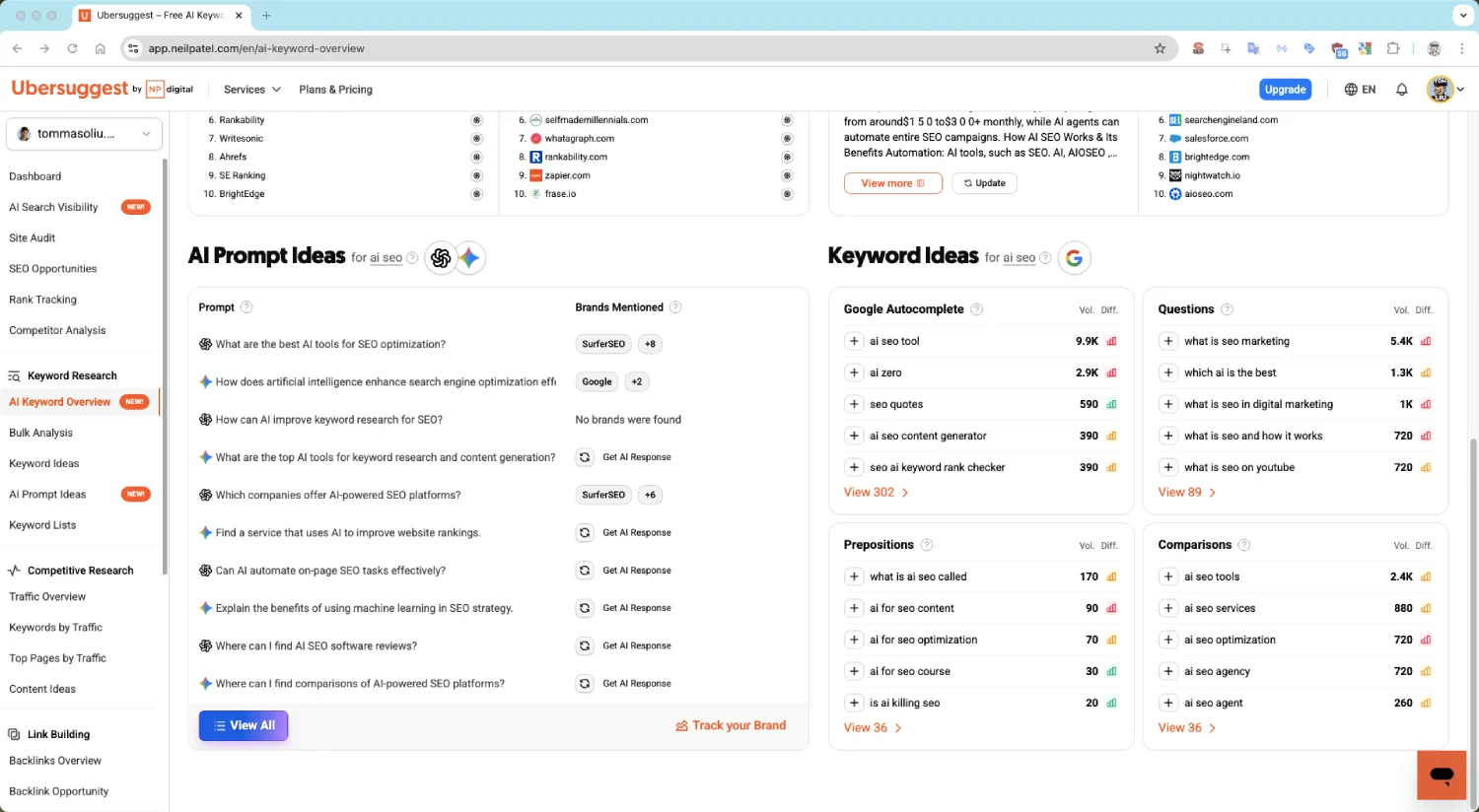
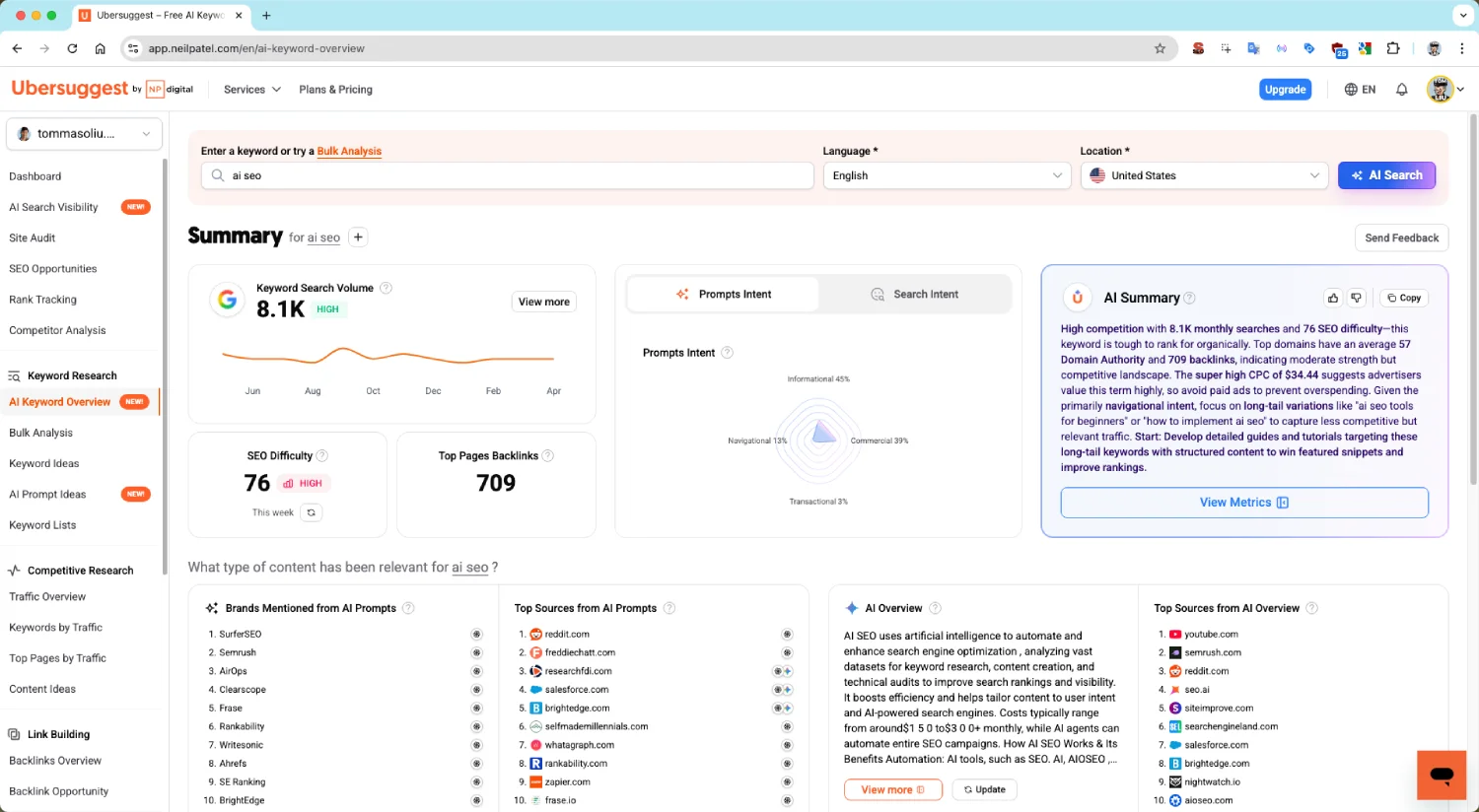
Use tools like Ubersuggest AI Keyword Overview to explore how people might ask about the same topic in AI tools.
Follow this process:
- Input each keyword – enter every important keyword planned for the page.
- Collect prompt ideas – look for questions that match the same topic and intent.
- Review intent and patterns – identify whether prompts are informational, commercial, or problem-solving.
- Check brands and sources – note which companies and websites appear in AI answers.
- Save useful prompts – keep only the ones that could become sections, FAQs, or new pages.
For example, for the page /ai-seo/, testing keywords like AI SEO, AI search optimization, and AI SEO strategy can generate prompts like:
| Keyword from page | Prompt ideas to collect |
|---|---|
| AI SEO | What are the best AI tools for SEO optimization? How can AI improve keyword research for SEO? Which companies offer AI-powered SEO platforms? |
| AI search optimization | How does artificial intelligence enhance search engine optimization efforts? Find a service that uses AI to improve website rankings. |
| AI SEO strategy | Explain the benefits of using machine learning in SEO strategy. Can AI automate on-page SEO tasks effectively? |
At this stage, focus only on collecting and expanding ideas. The next step is organizing them into the page structure.
3. Organize Keywords and Prompts Into the Page
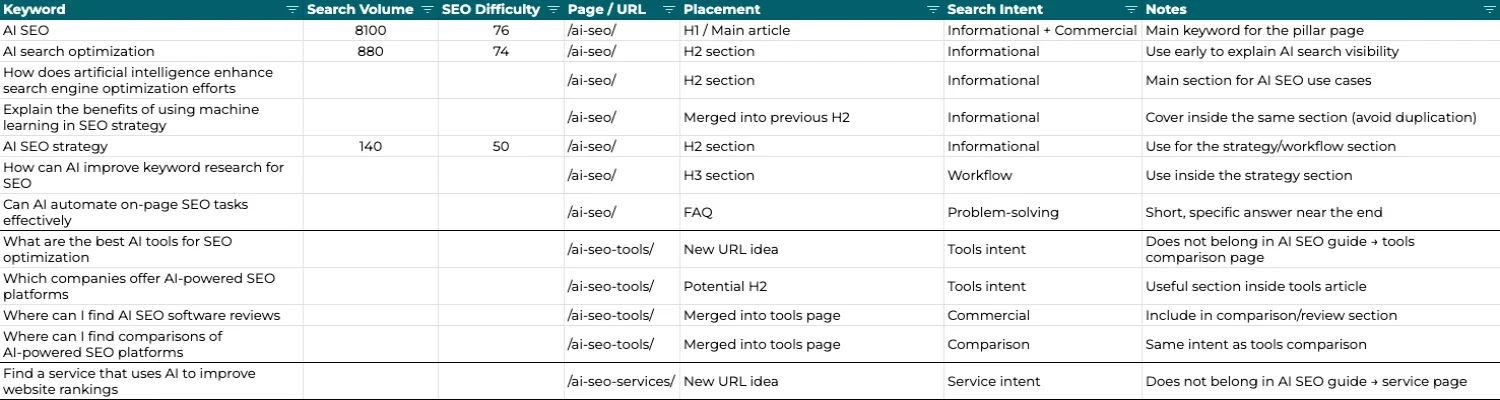
After collecting keywords and prompt ideas, organize them into the page structure.
The goal is to decide what belongs inside the current article and what should become a different page.
In the example spreadsheet, the page /ai-seo/ keeps the keywords and prompts that explain the main topic. The tool and service prompts are moved to new URL ideas because they have a different search intent.
Use this decision guide:
| Placement | When to use it |
|---|---|
| H1 / main article | Use for the main keyword or core topic, like AI SEO for the page /ai-seo/. |
| H2 section | Use for important subtopics with enough depth, like AI SEO strategy or AI SEO use cases. |
| H3 section | Use for smaller ideas inside an H2, like How can AI improve keyword research for SEO? inside a workflow section. |
| FAQ | Use for specific questions that need a short answer, like Can AI automate on-page SEO tasks? |
| Separate article | Use when the intent changes, like AI SEO tools or AI SEO services becoming their own pages. |
Do not force every keyword or prompt into the same article.
If the idea supports the same search intent, place it inside the page as an H2, H3, or FAQ. If it changes the intent, move it to a separate URL.
4. Repeat Keyword Research for New Page Ideas
As we saw in the previous example, some prompt ideas are too different to fit inside the current article.
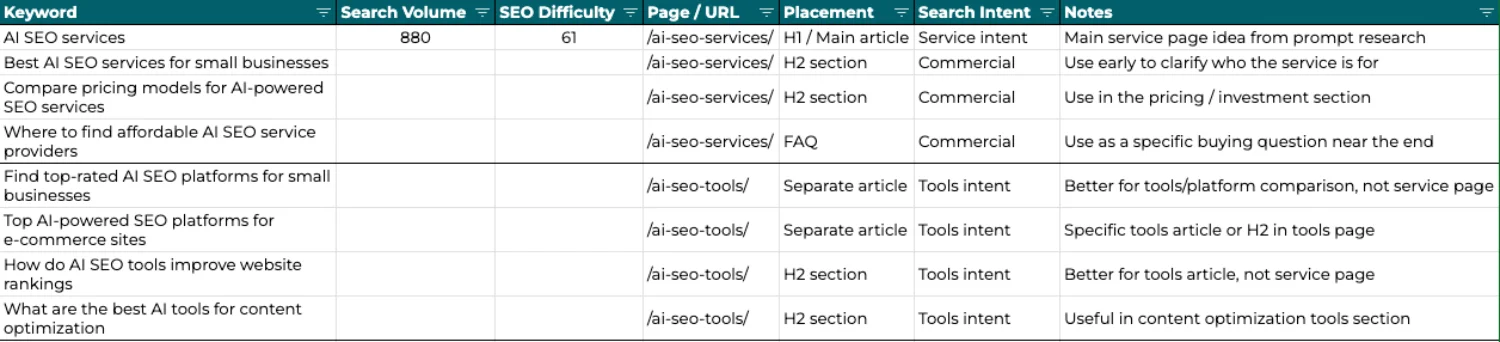
When a prompt has a different search intent, use it as a new URL idea, then restart keyword research for that specific topic.
For example, the prompt Find a service that uses AI to improve website rankings has service intent. It belongs on a commercial page, not inside an informational AI SEO guide.
Use that prompt to create a new keyword research loop:
- New URL idea: /ai-seo-services/
- Main keyword to check: AI SEO services
- Supporting keywords: AI SEO agency, AI SEO consultant, AI search optimization services
- Content type: service page or commercial landing page
This is where prompt research becomes useful: keywords create prompt ideas, and strong prompt ideas create new keyword research opportunities.
What is Search Intent in SEO? →
Informational Prompts
Informational prompts are used when someone wants to understand a concept. They usually start with what is, how does, or why does.
| Starting keyword | Informational prompt ideas |
|---|---|
| Local SEO | What is local SEO? How does local SEO work? Why does local SEO matter for small businesses? |
| Google Maps ranking | How does Google Maps ranking work? Why do some businesses rank higher on Google Maps? |
| Search intent | What is search intent? How does search intent affect SEO content? |
| Schema markup | What is schema markup? How does schema markup help Google understand a page? |
| Website speed | Why does website speed affect conversions? How does page speed affect SEO? |
| Service pages | What makes a good service page? Why do service pages need FAQs? |
These are usually the most common prompts, but also the least valuable for businesses. AI can answer them directly, so brand citations, clicks, and lead opportunities are often very limited.
Problem-Solving Prompts
| Starting keyword | Problem-solving prompt ideas |
|---|---|
| ChatGPT citations | Why is ChatGPT not citing my website? How do I get ChatGPT to mention my brand? |
| AI search visibility | Why is my business not appearing in AI answers? How do I improve visibility in AI search? |
| Google Maps ranking | Why is my business not showing on Google Maps? Why did my local ranking drop? |
| Website traffic | Why did my organic traffic drop? How do I find which SEO pages lost rankings? |
| Indexing | Why is Google not indexing my page? How do I fix pages discovered but not indexed? |
| Schema markup | Why is my schema markup not showing rich results? How do I check if schema is working? |
Comparison Prompts
Comparison prompts appear when the user is choosing between two or more options. They often include words like vs, best, alternative, compare, or difference.
| Starting keyword | Comparison prompt ideas |
|---|---|
| SEO vs Google Ads | Is SEO better than Google Ads? Which is better for small businesses, SEO or Google Ads? |
| ChatGPT vs Perplexity | Is ChatGPT or Perplexity better for SEO research? Which AI tool gives better sources? |
| GEO vs SEO | What is the difference between GEO and SEO? Is GEO replacing traditional SEO? |
| SEO consultant vs agency | Should I hire an SEO consultant or an SEO agency? What is the difference between an SEO consultant and an agency? |
| AI SEO tools | What are the best AI SEO tools? Which AI SEO platform is better for content optimization? |
| WordPress vs Shopify SEO | Is WordPress or Shopify better for SEO? Which platform gives more control over SEO? |
Comparison prompts are usually more valuable because the user is closer to a decision. They are strong candidates for tables, dedicated comparison articles, and service pages because brand mentions, citations, and lead opportunities are much more likely here.
Recommendation Prompts
Recommendation prompts appear when the user wants AI to suggest the best option. They often include words like best, top, recommended, tool, service, or provider.
| Starting keyword | Recommendation prompt ideas |
|---|---|
| AI SEO tools | What are the best AI SEO tools? Which AI SEO tools are best for small businesses? |
| AI search optimization | What is the best way to optimize for AI search? Which strategy works best for AI search visibility? |
| Local SEO services | Who offers the best local SEO services? What is the best local SEO service for small businesses? |
| SEO consultant | Who is the best SEO consultant for small businesses? How do I choose a good SEO consultant? |
| Content optimization tools | What are the best tools for content optimization? Which content optimization tool is best for SEO? |
| Google Business Profile tools | What are the best tools for managing Google Business Profile? Which tools help improve local SEO? |
Recommendation prompts are usually high-value because AI may mention brands, tools, services, or experts directly. They need clear criteria, strong examples, and trustworthy reasoning because the user is actively looking for something to choose.
Buying-Intent Prompts
| Starting keyword | Buying-intent prompt ideas |
|---|---|
| AI SEO consultant | Should I hire an AI SEO consultant? How do I choose an AI SEO consultant? |
| AI SEO services | Where can I find AI SEO services? What should AI SEO services include? |
| SEO consultant | How much does an SEO consultant cost? What should I look for when hiring an SEO consultant? |
| Local SEO services | How much do local SEO services cost? What should a local SEO service include? |
| SEO audit service | Do I need an SEO audit before hiring someone? What is included in an SEO audit? |
| AI search optimization service | Who can help me optimize for AI search? Is AI search optimization worth paying for? |
How to Test Prompts in ChatGPT, Perplexity, and Gemini
Testing prompts shows how AI tools answer your target questions and which sources they trust.
Use this simple process:
- Choose one prompt: start with a prompt from your spreadsheet, like Who can help me optimize for AI search?
- Test it in multiple tools: run the same prompt in ChatGPT, Perplexity, Gemini, and other AI search tools.
- Save the answer: record the response, cited sources, mentioned brands, and visible patterns in your spreadsheet.
- Compare results: check which brands, pages, and sources appear across multiple tools. Repeated mentions usually indicate stronger trust or visibility.
- Analyze patterns: look for repeated structures like steps, lists, definitions, or examples. These patterns show how AI prefers to answer the topic.
- Look for gaps: identify missing examples, weak explanations, outdated information, or unclear comparisons.
- Decide the content action: improve an existing page, add a section, create an FAQ, or plan a new article based on the gap.
The goal is not to get one perfect answer.
The goal is to understand what AI tools already trust, what they repeat, and where your content can become the better source.
How to Evaluate Prompt Results
Prompt results should be evaluated based on what AI tools actually return, not just the prompt itself. The goal is to understand how the answer is structured, which sources are trusted, and where your content can improve or replace existing results.
| Evaluation factor | What to check in the AI result |
|---|---|
| Brands and sources | Which companies, websites, or experts are mentioned or cited? Repeated appearances show current visibility and trust. |
| Answer structure | Is the answer a list, steps, comparison, or definition? This shows the format your content should match. |
| Consistency across tools | Do ChatGPT, Perplexity, and Gemini return similar answers or different ones? Consistency indicates a stable pattern. |
| Missing information | Are there gaps, vague explanations, outdated examples, or missing steps? These are opportunities to improve the answer. |
| Commercial signals | Are tools, services, or providers mentioned? This shows whether the prompt leads to brand visibility or just generic answers. |
The goal is to understand what AI tools already trust, what they repeat, and where your content can become a better, more complete source.
Content gap potential shows where your page can add something better than current results.
Useful gaps include missing templates, poor examples, unclear steps, absent definitions, or weak practical advice.
The best gap is specific enough to answer clearly and valuable enough to influence a decision.
Best Practices for Prompt Research
Good prompt research is structured, repeatable, and tied to real business goals. Random prompt lists are easy to create, but hard to use.
- Start with real data: use Search Console, SERPs, forums, and customer questions before AI brainstorming.
- Group by intent: keep prompts together only when they need the same answer type.
- Test across tools: compare ChatGPT, Perplexity, and Gemini instead of trusting one result.
- Prioritize value: choose prompts that support visibility, trust, leads, or positioning.
- Document patterns: track sources, gaps, repeated phrasing, and missing details.
Prompt research should create decisions, not another spreadsheet swamp.
Prompt Research Tools
Prompt research tools help you collect keywords, find questions, test AI answers, and track opportunities. Use tools to support judgment, not replace it.
| Tool type | How to use it |
|---|---|
| Search data | Google Search Console shows real queries your site already receives. |
| Keyword research | Ubersuggest, Ahrefs, and Semrush help expand topics and find prompt ideas. |
| AI testing | ChatGPT, Perplexity, and Gemini show how AI tools answer your prompts. |
| Manual tracking | Google Sheets or Notion can track prompts, citations, competitors, and gaps. |
No tool gives the full answer. The value comes from comparing tool data with real AI outputs.
Prompt Research Template
I created this prompt research template to help you turn raw prompt ideas into clear content decisions.
Use it to record each prompt, its intent, the AI results, the content gap, and the next action. The goal is to move from “interesting prompt” to “this should become an H2, FAQ, new article, or service page.”
FAQs About Prompt Research
What is prompt research in SEO?
Prompt research in SEO is the process of finding the questions people ask AI tools before making decisions. It helps you create content that answers real prompts, matches user intent, and improves your chance of being mentioned or cited in AI-generated answers.
How is prompt research different from keyword research?
Prompt research focuses on full questions, while keyword research focuses on search terms. A keyword may be AI SEO. A prompt may be how can I make my website appear in ChatGPT answers? The prompt reveals more context and decision intent.
How do you find prompt ideas?
You find prompt ideas by combining SEO data with real user language. Use Search Console queries, autocomplete, People Also Ask, Reddit threads, customer questions, and AI answer testing. Then turn short keywords into complete questions with goals, constraints, and audience context.
What tools can you use for prompt research?
You can use Google Search Console, SEO tools, AI platforms, Reddit, and spreadsheets for prompt research. Search Console gives real queries, SEO tools expand ideas, AI platforms test answers, and spreadsheets help track citations, competitors, gaps, and content actions.
Should every prompt become a separate article?
No, every prompt should not become a separate article. Prompts with the same intent should usually live on the same page as sections or FAQs. Create a separate article only when the prompt has a different audience, format, search intent, or business goal.
How often should you repeat prompt research?
Prompt research should be reviewed regularly because AI answers change over time. A practical rhythm is to retest priority prompts when publishing new content, updating service pages, or noticing competitor changes in ChatGPT, Perplexity, Gemini, or Google search results.
