


Key Takeaways
- AI SEO focuses on being recommended by AI platforms, not just ranked
- Product discovery starts on AI tools, not only Google or marketplaces
- Queries are longer, specific, and intent-driven
- Product, category, and comparison pages drive visibility
- Clear positioning matters more than generic product listings
- Technical SEO ensures AI can access and use your data
- External signals (reviews, mentions) influence recommendations
- Keyword research now includes queries and prompts
- Fewer products are shown, competition for selection is higher
- Conversion matters more, traffic alone is not enough
What Is AI SEO for Ecommerce
AI SEO for ecommerce is search engine optimization applied to AI systems like ChatGPT, Gemini, and Perplexity, where the goal is to make your products easy to understand, compare, and recommend inside their answers.
Instead of focusing only on rankings, you organize your store, content, and signals so these systems can find, interpret, and use your information when people ask what to buy.
In practice, this means building a store and online presence that shows up in the right places and gets picked up by AI when users search for specific products or solutions.
How AI Search Changes Ecommerce Product Discovery
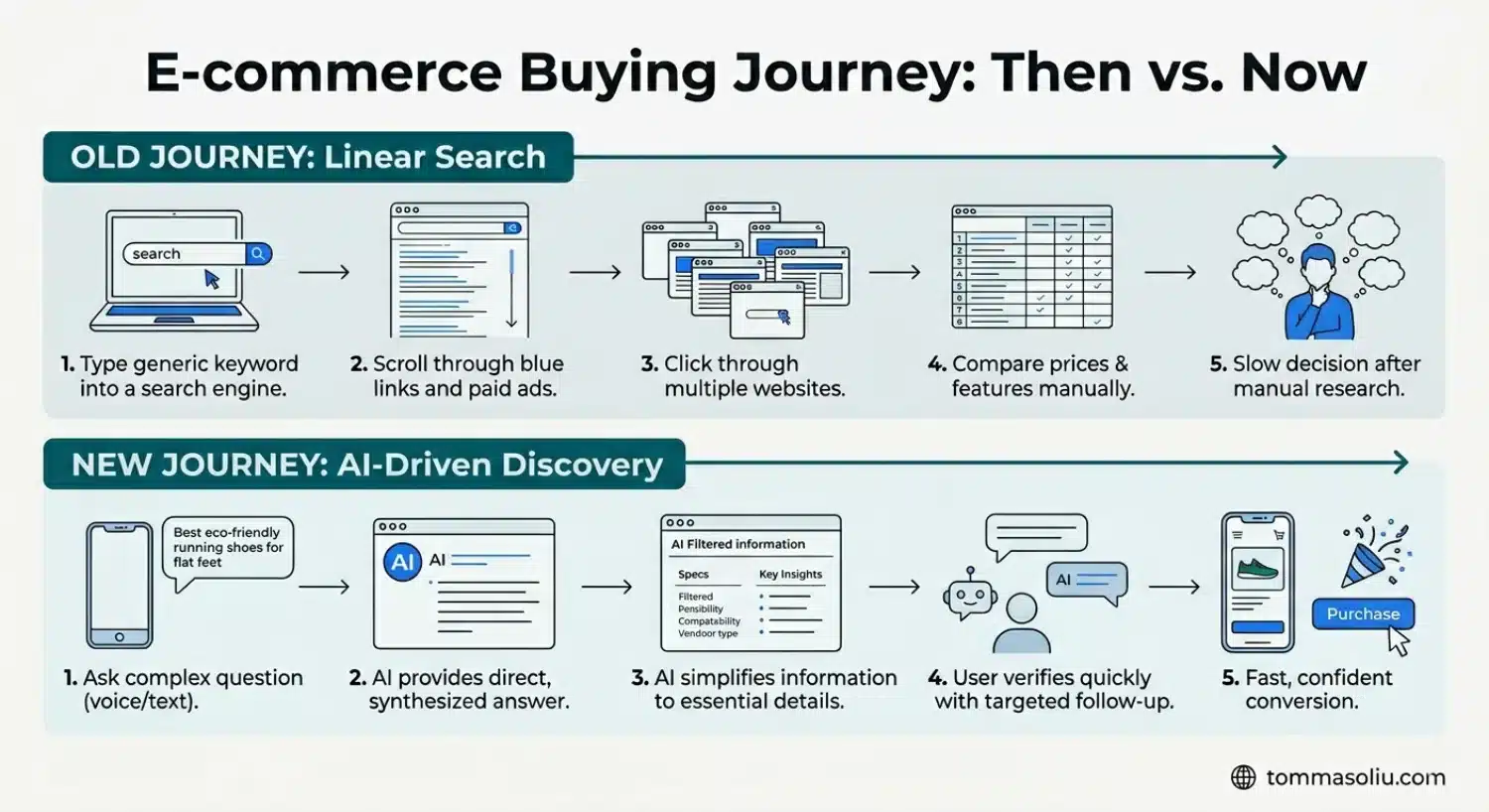
AI search has changed how people move from “I need something” to “I’ll buy this.”
Instead of browsing and comparing manually, users now get guided toward a few selected options much earlier in the process.
| Before (Traditional Ecommerce Journey) | Now (AI-Driven Product Discovery) |
|---|---|
| Search on Google or marketplaces like Amazon, AliExpress, SHEIN | Ask AI tools like ChatGPT or Gemini |
| Browse categories and apply filters | Start with a specific need or request |
| Open many product pages | Get a shortlist immediately |
| Compare products manually | AI compares options automatically |
| Read reviews across multiple sites | AI aggregates signals and opinions |
| Do research alone | Ask follow-up questions and refine results |
| Evaluate price, features, needs manually | AI analyzes buying factors upfront |
| Decide after long browsing sessions | Decide faster with fewer steps |
This shifts product discovery from manual research to guided decision-making.
The Most Important Ecommerce Pages for AI SEO
Not all pages contribute equally to AI visibility.
Some pages help AI understand your products, others help it recommend them when users ask what to buy.
Focus on the ones that influence both discovery and decision.
| Page Type | Role in AI SEO (with example) |
|---|---|
| Product Pages | Explain the product clearly so AI can recommend it. Example: a running shoe page that states “best for flat feet under 80kg” |
| Category Pages | Organize products by intent, not just type. Example: “Running shoes under 150€” or “Shoes for beginners” |
| Comparison Pages | Help AI evaluate alternatives. Example: “Nike vs Adidas running shoes for beginners” |
| Listicles (“Best X”) | Match recommendation queries. Example: “Best running shoes for flat feet under 150€” |
| FAQ Pages | Answer specific buying questions. Example: “Are running shoes good for walking?” |
| Buying Guides | Help users choose based on needs. Example: “How to choose running shoes for beginners” |
Product and category pages structure your store.
Content pages explain and support decisions.
AI uses both to decide what gets recommended.
How to Do AI SEO for Ecommerce
Start simple. AI SEO for ecommerce is not a new system.
It’s the same fundamentals, applied to how people search and decide today.
Focus on these five areas:
- Find real buying queries, not just keywords
- Build pages that match those specific needs
- Make your site easy to crawl and understand
- Show consistent signals across the web
- Track what gets visibility and drives sales
Everything else is secondary.
If your store aligns with how people ask, compare, and choose products,
AI systems will pick it up and use it.
That’s the whole game.
Keyword Research for AI SEO in Ecommerce
Keyword research for AI SEO in ecommerce is about finding the questions, comparisons, and buying constraints people use before choosing a product.
That includes classic keyword research, but also prompt research: the longer, more specific searches people now type into AI tools when they want recommendations.
| Query Type | Real Example (High-Intent) |
|---|---|
| “Best” queries | best air fryer for small kitchen |
| Price constraints | best smartwatch under 200 |
| Use case / audience | mattress for side sleepers |
| Comparisons | dyson vs shark vacuum |
| Problem-based | moisturizer for sensitive skin |
| Feature-specific | waterproof bluetooth speaker |
Many SEO tools are moving in this direction.
Platforms like Ubersuggest, Ahrefs, and Semrush are expanding into more natural-language and prompt-style research, which helps uncover how people ask, not just what they type.
How to do keyword research for ecommerce:
- Start with product, use case, budget, and features
- Check Google autocomplete and People Also Ask
- Study Amazon, Reddit, forums, and customer reviews
- Look at competitors’ product, category, and blog pages
- Find “best”, “for”, “under”, “vs”, and problem-based queries
- Note recurring features buyers care about
- Map each query to the right page type
- Prioritize buying intent, not just search volume
The goal is to find the queries that reveal what people want, what they compare, and what features drive the purchase.
Technical SEO for Ecommerce AI Visibility
Technical SEO for ecommerce ensures your store can be found, accessed, and understood by both search engines and AI systems.
If this layer is weak, even great products won’t show up.
| Area | What to Do (with example) |
|---|---|
| Structured Data (Schema Markup) | Add product schema with price, stock, reviews so AI can extract details |
| Internal Linking | Link products, categories, and guides (e.g. product → “best for beginners”) |
| Page Speed | Load fast on mobile to avoid drop-offs and crawling issues |
| Crawlability | Use clean URLs and ensure pages are indexable |
| Product Feeds | Submit products to Google Merchant Center and Bing |
| Search Consoles | Connect Google Search Console and Bing Webmaster Tools |
This layer is not about tricks.
It’s about making your store easy to access, connect, and interpret.
If AI can’t read it properly, it won’t recommend it.
On-Page SEO for Product, Category, and Content Pages
On-page SEO is where your pages become usable for both users and AI systems.
Each page type plays a different role in helping users understand and choose a product.
Product pages
- Write specific titles and headings with keywords and queries
- Add who it’s for and when to use it
- Include comparisons and alternatives
- Highlight key features, price, and variations
- Avoid duplicate or manufacturer descriptions
Category pages
- Add a short intro explaining the category
- Group products by use case, price, or audience
- Use clear, intent-based headings
- Link to relevant products and guides
Blog / articles
- Focus on one query or topic per page
- Answer the question directly, without fluff
- Use clear headings and structured sections
- Add FAQs based on real user questions
- Link to relevant products and categories
The goal is simple: Make every page easy to understand, scan, and use in a decision.
How to Optimize Content in AI Search →
Build Authority and Entity Signals
Authority and entity signals help AI systems decide if your store is trustworthy enough to recommend.
It’s not just about your website.
It’s about how your brand shows up across the web.
- Collect reviews on Google, marketplaces, and your site
- Get mentioned in blogs, YouTube, Reddit, and forums
- Keep your brand name and description consistent everywhere
- Build profiles on key platforms (social, directories, marketplaces)
- Encourage user-generated content (reviews, videos, posts)
AI systems compare multiple sources.
If your brand appears consistently and positively across them, it becomes easier to trust, connect, and recommend.
Track SEO and AI Search Performance
Tracking SEO and AI search performance shows what actually drives visibility and sales.
Without it, you’re guessing.
| What to Track | How to Track It |
|---|---|
| Search impressions and clicks | Use Google Search Console → Performance report |
| Queries bringing traffic | Check queries tab in Search Console |
| Product and category traffic | Use Google Analytics → Pages and screens |
| Conversion rate and revenue | Track ecommerce events in Analytics |
| Drop-offs in the journey | Analyze funnels and user paths |
| AI visibility | Search manually in ChatGPT, Gemini, or use tools like Ubersuggest, Ahrefs |
| Competitor presence | Compare which brands appear in results |
Focus on outcomes, not just rankings.
What matters is which pages bring buyers, and which ones get ignored.
How to Use AI Tools for Ecommerce SEO
AI tools can make ecommerce SEO faster, easier to scale, and easier to research, but they work best when they support a clear strategy.
Use them to speed up analysis, drafting, and structured SEO tasks.
| Use AI For | Example |
|---|---|
| Improving product descriptions | Turn generic supplier copy into clearer, more specific product copy |
| Clustering keywords / queries from keyword research | Group similar queries into product, category, comparison, and blog page ideas |
| Finding content opportunities | Generate “best”, “vs”, “for”, and FAQ angles around your products |
| Extracting FAQs from reviews | Turn recurring customer questions into FAQ sections and article ideas |
| Generating JSON-LD schema markup | Create Product, FAQ, Review, or Breadcrumb schema markup faster |
| Creating first drafts | Outline blog posts, category intros, and comparison pages |
| Researching AI visibility | Check whether your brand or products are mentioned in AI answers |
| Studying competitors | Analyze which competitors get recommended and what signals they have stronger than you |
Use AI to study what is already being mentioned, what competitors are doing better, and where your store is missing visibility. It can save hours of manual work, but the strategy, final review, and publishing decisions should still come from you.
The Future of AI SEO for Ecommerce
The future of AI SEO for ecommerce is about adapting to how decisions are made, not just how pages are optimized.
What matters is how you position your store as AI becomes the main filter between users and products.
- Narrow your focus instead of listing everything for everyone
- Make each product easy to position against alternatives
- Treat reviews and mentions as part of your product, not marketing
- Invest in brand, social content, and video across platforms
- Explore formats like live shopping as part of the buying journey
- Build a fast, frictionless funnel from discovery to purchase
AI reduces options before users even visit a site.
That means your advantage is not more pages or more traffic,
but being clear, trusted, and easy to buy from when you are shown.
Start Optimizing Your Ecommerce Store for AI Search
AI search is already deciding which products get seen and which get ignored.
If your store needs better visibility, structure, and conversion to turn discovery into sales, this is where I can help.
- Audit your store structure, pages, and missed opportunities
- Find high-intent queries and map them to the right pages
- Optimize product, category, and content pages for selection
- Strengthen trust signals and presence across platforms
- Improve design, speed, and conversion paths
If you want this implemented properly without wasting time testing blindly, this is exactly the type of work I help ecommerce stores with.
FAQs about AI SEO for Ecommerce
Is AI SEO only for large ecommerce stores?
No. Smaller stores can compete more easily by focusing on specific niches and high-intent queries instead of broad keywords.
Does AI SEO replace traditional ecommerce SEO?
No. It builds on it. Technical SEO, content, and structure still matter, but the goal shifts from ranking pages to being selected.
How long does it take to see results from AI SEO?
- 2–4 weeks → early signals (new queries, impressions, occasional AI mentions)
- 1–3 months → visible traffic growth on key pages
- 3–6 months → consistent visibility and impact on sales
Stores with existing content, traffic, and authority tend to see results faster, while new or unstructured stores take longer to build visibility.
Should I create pages even if they have low search volume?
Yes. Many high-intent queries don’t show volume in tools but still drive qualified traffic and sales through AI search.
Do product reviews impact AI recommendations?
Yes. Reviews are one of the strongest signals used to validate and compare products across sources.
Is AI SEO different for physical vs digital products?
The principles are the same. The difference is in the queries and content, but both rely on clarity, structure, and trust signals.
