

Key Takeaways
- Visibility happens before the click — AI answers directly, often without a website visit
- Being cited builds brand authority and drives branded search, even without traffic
- GEO extends SEO, not replaces it — rankings and technical foundations still feed AI visibility
- ChatGPT, Gemini, and Perplexity each select and cite content differently
- One page, one intent — mixed topics are harder for AI to extract and trust
- Authority is validated across the web — mentions, directories, and consistency all count
- GEO is a system — strategy, content, and authority compound over time
- Citations, branded search growth, and AI referral traffic are all measurable today
What is Generative Engine Optimization (GEO)?
Generative Engine Optimization (GEO) is the practice of structuring content so AI systems can retrieve, understand, and cite it inside generated answers. It applies to ChatGPT, Perplexity, Google AI Overviews, Gemini, and Claude.
GEO works at the level of topics and questions rather than individual keywords. An AI engine pulls a passage because it directly answers what was asked, so the unit of optimization becomes the extractable statement, not the page.
Three signals determine whether your content gets selected:
- Entity clarity – tells the engine who you are and what you are authoritative on
- Answer-first formatting – makes individual passages liftable without surrounding context
- Complete topic coverage – establishes you as a consistent source across related questions
GEO vs SEO: What Changed
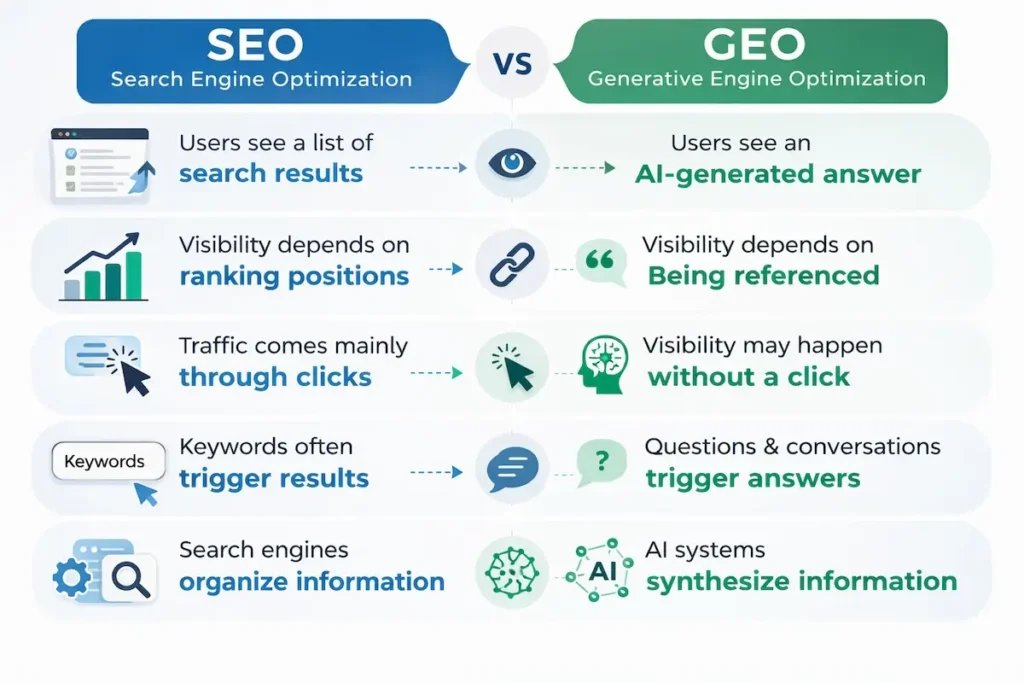
GEO extends SEO rather than replacing it.
Google states this in its own documentation: SEO best practices remain relevant for AI features, because those features run on the core Search ranking systems. There is no separate track.
What changes is the outcome you are optimizing for, and four assumptions behind it:
- Pages → topic systems. One strong article is not enough. A page on dental implants needs supporting articles on cost, recovery, and candidacy before the cluster reads as authoritative.
- Keywords → prompts. Nobody types “geo services spain” into ChatGPT. They ask who can help their SaaS get cited in AI answers. You target the question, not the keywords.
- Readers → readers and extraction. A person reads the page naturally, and an engine lifts a 40-word answer without reading the rest. Both have to work.
- Publishing → distribution. A post that only lives on your blog has one entry point. The same idea on LinkedIn, in a video, or on a podcast gives AI several places to corroborate you.
GEO vs SEO: 5 Key Differences in AI Search →
Why Generative Engine Optimization Matters in 2026
AI answers now sit between your buyer and your website. GEO decides whether you appear inside that answer or get skipped before anyone reaches your site.
- Visibility without the click – around 68% of US Google searches end without a click, but a citation still puts your name in front of the buyer
- Earlier influence – buyers shortlist inside AI tools before they ever compare vendors directly
- Recommendation, not just ranking – being named as a suggested option carries more weight than position four in a list of links
- Compounds your SEO – same content, structure, and authority signals, packaged for extraction
- Low competition window – most sites have no GEO strategy yet, so citation positions are cheaper to win now
How AI Search Works
AI search engines do not return a list of links. They retrieve relevant sources, synthesize them, and generate a single answer with citations.
Each platform retrieves differently, which is why GEO is not one-size-fits-all.
| Platform | How it finds and uses your content |
|---|---|
| ChatGPT | Blends training data with live browsing. Favors clear, authoritative, well-structured explanations. |
| Gemini | Built on Google’s core Search ranking systems. Strong SEO fundamentals carry over directly. |
| Perplexity | Crawls in real time and cites sources on every answer. Rewards factual, verifiable content. |
| Claude | Answers from training data unless the query needs current information. Third-party brand mentions matter more than on-site optimization. |
What is Query Fan-Out in AI Search?
AI search engines rarely search for the exact question a user types. Instead, they break it into several related sub-queries, run them at the same time, and build the answer from the combined results. This is called query fan-out, and it changes what gets cited.
A page can be cited without ranking for the original question at all, because it ranked for one of the sub-queries instead.
Ahrefs found that only 37.9% of AI Overview citations come from pages ranking in Google’s top 10 for that exact query, down from around 76% a year earlier.
This is the mechanism behind two rules already covered on this page: why one page should answer one intent, and why topic clusters outperform single strong articles.
A cluster gives you one eligible page per sub-query. A single page only competes for one.
Query Fan-Out →
What Influences AI Visibility: GEO Ranking Factors
GEO is not about ranking pages. It is about becoming a source AI systems choose to cite.
Six signals appear to drive selection today:
| GEO ranking factor | What it means |
|---|---|
| Topical depth | Covering a subject fully, not scratching the surface |
| Entity clarity | Making it obvious who you are and what you do, consistently |
| Original insight | Saying something others are not, backed by real experience |
| Cross-platform presence | Existing in more than one place so AI can corroborate you |
| Extractability | Structured so a passage can be lifted whole: lists, tables, definitions |
| Authority signals | Credibility and consistency across your site and the wider web |
These are observed patterns, not confirmed ranking factors. Google states there are no special optimizations required to appear in AI Overviews.
What we have is what correlates with citation today.
12 GEO Ranking Factors for AI Search →
How to Do GEO: A Practical Framework
Generative Engine Optimization works as a system of reinforcing signals, not a checklist applied to one page. Six areas determine whether AI engines treat you as a source worth citing.
1. Define your topic territory
Pick a small number of subjects you intend to own completely, then cover them before going wide. Partial coverage of ten topics loses to full coverage of two.
- Choose by commercial relevance, not volume – the test is whether a buyer asking that question is someone you can sell to
- Start with pre-sale questions – what clients asked before hiring you maps directly to the prompts buyers run now
- Finish a territory before opening another – depth is what makes the cluster readable as authoritative
2. Map your entity
AI engines need to resolve who you are before they can recommend you. Inconsistency is the common failure, not absence.
- Fix the canonical version first – name, role, specialism, location, written once and propagated
- Audit every surface – site, author bios, social profiles, directories, guest posts, old bios
- Markup helps, consistency matters more – schema on one page cannot fix conflicting signals across ten
3. Build pillars and clusters
One comprehensive pillar page per territory, surrounded by articles answering a single question each. The pillar establishes scope, the clusters supply the extractable answers.
- Link in both directions – clusters point up to the pillar, the pillar points down with anchor text naming each question
- One intent per page – an article answering three questions gets cited for none of them
- Write the pillar last – it is easier to scope once you know what the clusters cover
4. Add pages that generate leads
Getting cited and getting clients are not the same goal. Informational content builds authority, commercial pages convert it.
- Service and location pages – connect your entity to a specific offer and market
- Comparison and provider pages – these are what AI pulls from when someone asks who to hire rather than what something is
- The risk of skipping this – you become the source explaining the category while competitors get recommended in it
7 Content Types that Generate Leads in AI Search →
5. Earn external mentions
AI engines validate across the web, not just your domain. A claim about yourself carries less weight than the same claim on someone else’s site.
- Where GEO diverges most from on-page SEO – a thinner site with more third-party presence can outrank a perfectly optimized one
- Prioritize sources AI already cites – industry directories, established publications, podcasts with transcripts
- Consistency compounds here too – mentions only reinforce the entity if the details match
Link Building for SEO →
6. Keep the SEO foundations solid
Everything above depends on your pages being crawlable, indexed, and eligible for snippets. AI features draw from the same index as organic search.
- A page blocked from Search is invisible to AI – robots.txt, noindex, and render-blocking JavaScript all apply
- Keep information current – stale figures lose credibility with AI the same way they lose rankings
- No special markup required – Google confirms there is no AI-specific schema or file to add.
Technical GEO covers the infrastructure behind AI visibility: crawlability, rendering, indexing, internal linking, structured data, and clear site architecture. These elements do not guarantee citations, but they ensure AI search engines can access and understand your content in the first place.
Technical GEO →
How to Optimize Content for AI Search
Once the system is in place, each page needs to be written so an engine can lift an answer from it. Start with the habits that make the biggest difference.
- Answer first – lead with the direct answer, then expand. Engines pull from the top of a section, not the bottom
- Write self-contained headings – each section should answer its question without needing the sections around it for context
- Structure with lists and tables – formatted content extracts more cleanly than dense paragraphs
- Name entities explicitly – say the tool, brand, concept, or city by name. Do not assume the engine infers it from context
- Add proof and specifics – data, real examples, and case studies are more citation-worthy than generic explanation
- Keep passages self-sufficient – avoid “as mentioned above” or “this approach,” since a lifted paragraph loses whatever it points back to.
How to Optimize Content in AI Search →
How to Measure GEO Performance
GEO does not report like SEO. There is no rank tracker for a citation, and most of the value shows up in metrics you already have but read differently.
| What to track | Why it matters |
|---|---|
| AI citations and mentions | Whether you appear in answers for your target prompts, and how you are described |
| Referral traffic from AI sources | Visits from ChatGPT, Perplexity, and Gemini, split out in analytics |
| Google Search Console AI reports | Impressions and clicks from AI Overviews and AI Mode, reported separately since June 2026 |
| Branded search volume | Rising brand queries often mean AI is recommending you before the click |
| Share of voice against competitors | Who gets named when a buyer asks for options in your category |
| Lead source self-reporting | Asking new leads where they heard about you catches what no tool tracks |
Impressions and citations are leading indicators. Leads and revenue are the ones that pay.
Generative Engine Optimization Tools
You do not need a dedicated GEO platform. Four tools cover the work, and two of them are free.
| What to get | Why you need it |
|---|---|
| Google Search Console (free) | Shows which questions bring people to your site and whether your pages are indexed. Non-negotiable, set it up first |
| An SEO platform (Ubersuggest, Ahrefs, Semrush) | Finds the questions worth answering and checks how competitors cover them. Start with the cheapest, they all do the basics |
| An SEO plugin or equivalent (Rank Math, Yoast) | Controls your titles, headings, and schema markup. On WordPress it is a plugin, elsewhere your CMS or developer handles it |
| AI chatbots (ChatGPT, Claude, Perplexity) | Your testing bench. Paste a section, ask for a summary, and rewrite if the answer comes back vague. Also where you check whether you get cited |
If you already do SEO, you likely have the first three. The fourth is the only genuinely new habit.
Generative Engine Optimization Tools: The AI Search Stack →
The Future of Generative Engine Optimization
Search behavior is changing more than the search companies are. Keyword-style queries give way to conversational prompts, follow-up questions, and voice, and Google is converging its own products toward that model rather than defending the old one.
What that means in practice:
- Prompting becomes the default – longer, more specific, more conversational queries, often spoken rather than typed
- One answer, not ten links – engines converge toward a single response, so appearing in it stops being optional
- Brand becomes the ranking signal – when engines corroborate across sources, the recognized name wins over the better-optimized page
- Visibility becomes a requirement, not a choice – businesses that stay off third-party surfaces get harder to verify, and harder to recommend
The practical response is to stop treating channels as separate efforts. One piece of research should become an article, a LinkedIn post, a video, and a podcast answer. Every format is another surface an engine can find and corroborate you on.
Getting Started With GEO
Most businesses do not need a new content strategy. They need the one they already have restructured so AI engines can read, trust, and cite it.
That work is specific to your site. Which topics you can realistically own. Where your entity is described inconsistently. Which pages are close enough to rewrite rather than replace.
It is hard to judge from a checklist, and straightforward to see from the outside.
Send me your website and I will review your search and AI visibility before we speak, so the call focuses on real opportunities rather than general advice.
FAQs About Generative Engine Optimization
How long does GEO take to show results?
Longer than most people expect, and shorter than building SEO from scratch. Some signals — like being cited in Perplexity for a well-structured page — can appear within weeks.
Building consistent AI visibility across ChatGPT, Gemini, and AI Overviews takes months of sustained content and authority work.
The compounding nature means early efforts pay off more over time.
Does GEO work for small businesses?
Yes — especially local service businesses, medical and dental clinics, and professional services where people ask AI for recommendations before searching Google.
A small business with deep, clear content on a specific topic can outperform larger competitors with generic coverage.
Do I need a big website to get cited by AI?
No. AI systems prioritize clarity, structure, and topical depth over domain size.
A focused site with ten well-structured articles on one topic can get cited more consistently than a large site with shallow coverage across many topics.
Can I do GEO without doing SEO first?
Not effectively. SEO builds the technical and authority foundations that AI systems rely on — indexing, crawlability, backlinks, and on-page structure.
GEO extends that foundation.
Skipping SEO means starting without the base AI search builds on.
How is GEO different from AEO?
AEO (Answer Engine Optimization) focuses specifically on getting content featured in direct answer formats — featured snippets, voice search, and FAQ results. GEO is broader — it covers being cited, mentioned, or used as a source across all AI-generated responses, not just structured answer boxes.
In practice the two overlap significantly.
Is GEO relevant if my business is not online-only?
Yes. Local businesses are among the most affected by AI search because people increasingly ask AI for nearby providers, opening hours, and service comparisons before ever visiting a website.
Physical businesses that ignore GEO risk losing visibility at the earliest stage of the customer journey.
Will GEO still matter if AI search keeps changing?
The specific tactics will evolve. The fundamentals won’t.
Clear content, strong entity signals, topical depth, and external credibility are the same things that have always determined trustworthiness online — AI systems are just evaluating them differently.
Building on those foundations is never wasted effort.
Articles related to Generative Engine Optimization (GEO)
- Generative Engine Optimization Services
- What Is AEO? (AI Engine Optimization Explained)
- 12 GEO Ranking Factors
- 7 Content Types That Improve AI Search Visibility
- GEO vs SEO: 5 Key Differences in AI Search
- SEO Services | Get More Traffic & Customers
- How to Optimize Content for AI Search Visibility
- ChatGPT SEO: How to Rank in ChatGPT
