

What Is Content Strategy for SEO?
Content strategy for SEO means deciding what content to create, who it is for, and how each page helps your website grow.
Instead of publishing random articles and hoping something ranks, an SEO content strategy gives each page a job.
That means choosing topics intentionally, organizing pages logically, and making sure content supports both search visibility and business goals.
A good content strategy answers questions like:
- What topics should this website own?
- Which pages should exist?
- What should be updated instead of rewritten?
- How do pages support each other?
- Which content actually drives leads or sales?
Less content. More purpose.
SEO content strategy is not writing.
It is deciding what deserves to be written in the first place.
Why SEO Content Strategy Matters
SEO content strategy matters because it increases the probability that your content gets discovered, understood, trusted, and selected by search engines and AI systems.
A single optimized page is no longer enough.
Your website needs clear topics, connected pages, and consistent content that reinforces itself.
A study in 2023 by Ahrefs found that 96.55% of pages receive no organic traffic from Google (and I doubt competition got easier as years go by…).
A clear SEO content strategy helps you:
- Choose topics with realistic ranking potential
- Prioritize pages with business impact
- Organize content into logical clusters
- Connect related pages through internal links
- Decide whether content should be created, updated, merged, or removed
- Build momentum instead of restarting from zero.
AI search makes strategy even more important. AI systems look for clear answers, trusted sources, and connected information.
Without strategy, pages sit alone.
With strategy, content becomes a system.
Types of SEO Content Strategies
Different businesses need different SEO content strategies. A local dentist, SaaS company, and e-commerce store should not publish the same type of content. Same game, different shoes.
| Business type | Best SEO content strategy |
|---|---|
| Local service business | Service pages, local pages, FAQs, reviews |
| SaaS business | Feature pages, comparison pages, use cases |
| E-commerce store | Category pages, product pages, buying guides |
| Personal brand | Thought leadership, guides, case studies |
| B2B service business | Problem pages, case studies, industry pages |
| Content website | Topic clusters, tutorials, evergreen guides |
How to Build Your Content Strategy for SEO
A good SEO content strategy starts before writing and continues after publishing.
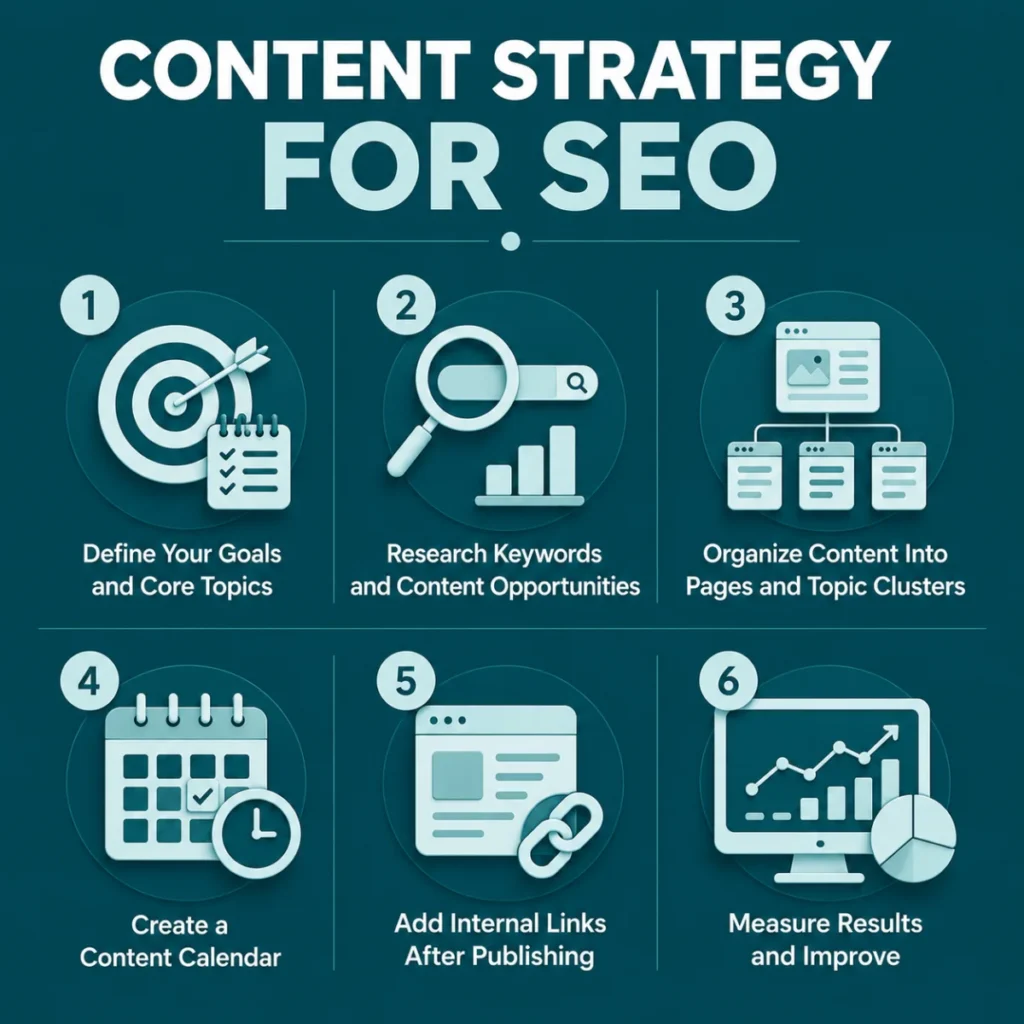
Follow these steps:
- Define your goals and core topics: decide what the website should achieve and become known for.
- Research keywords and content opportunities: find search demand, competitor gaps, and content ideas.
- Organize content into pages and topic clusters: decide which pages should exist and how they support each other.
- Create a content calendar: prioritize what to publish, update, and maintain.
- Add internal links and publish: connect related pages and strengthen the content structure.
- Measure results and improve: decide what to keep, update, merge, expand, or remove.
1. Define Your Goals and Core Topics
Before researching keywords, decide what the content strategy must help the business achieve.
Then choose the core topics that directly support those goals. This keeps the website focused and stops random keyword chasing.
| Question | Example answer |
|---|---|
| What should content achieve? | Leads, sales, bookings, demos, traffic |
| Who should the content attract? | Buyers, researchers, users, local customers |
| What offers should content support? | Services, products, tools, resources |
| What topics should the site own? | 3–5 main content categories |
| What should be ignored? | Informational-only, wrong-audience, or unrealistic keywords |
The goal is simple: every core topic should support a real business outcome.
What is Search Intent in SEO? →
2. Research Keywords and Content Opportunities
Once your goals and topics are clear, research which content opportunities are worth pursuing.
Keyword research is a full topic on its own. Here, the goal is simple: find keywords that fit your business, audience, and content strategy.
You can research keyword ideas using:
- SEO tools: Ubersuggest, Ahrefs, Semrush, SE Ranking
- Google Suggest: autocomplete, related searches, People Also Ask
- Google Search Console: queries already bringing impressions
- Competitor pages: topics ranking websites already cover
- AI tools: keyword angles, clusters, FAQs, content gaps
- Customer language: sales calls, reviews, emails, support questions
Do not just collect keywords.
Filter them by relevance, difficulty, business value, and whether they deserve a page.
Keyword Research →
3. Organize Content Into Pages and Topic Clusters
After keyword research, organize the ideas into pages before writing anything.
This prevents duplicate articles, keyword cannibalization, and random blog posts floating around like lost socks.
- Group related keywords together: keep similar searches under one page or cluster.
- Choose the main page: decide which topic needs a pillar page, service page, or guide.
- Plan supporting pages: add related articles that answer narrower questions.
- Map one main keyword per page: avoid creating multiple pages for the same intent.
- Connect the cluster: plan links between the main page and supporting pages.
The goal is not to publish every keyword.
The goal is to build a structure where each page has a clear role.
7 Content Types That Improve AI Search Visibility →
4. Create a Content Calendar
A content calendar turns strategy into execution.
The goal is not to publish as often as possible. The right cadence depends on your business stage, resources, and existing content.
| Situation | Suggested publishing cadence |
|---|---|
| New website | 1–3 pages per week |
| Small local business | 1–2 pages per month |
| Growing business | 2–4 pages per month |
| Established website | Mostly updates + selective new pages |
| Large content website | Multiple pages per week |
| Low resources | Publish less, update more |
Publishing faster helps only if quality and structure stay consistent.
A slow, focused calendar usually beats an abandoned “daily content” plan.
5. Add Internal Links After Publishing
Publishing a page is not the final step.
After it goes live, connect it to the rest of the website. This helps users find related content and helps search engines understand how pages work together.
- Add links from the new page: link to related articles, service pages, pillar pages, and useful external sources.
- Add links from older pages to the new page: update existing content so it points to the new article where relevant.
- Check for orphan pages: find pages with few or no internal links.
Internal linking should be planned during strategy and completed after publishing.
Link Building SEO →
6. Measure Results and Improve
SEO content strategy does not stop after publishing.
Measure what is working, then decide what to update, expand, merge, or remove.
- Review search performance: use Google Search Console to check impressions, clicks, CTR, and ranking queries.
- Analyze user behavior: use Google Analytics to understand visits, engagement, and conversions.
- Monitor rankings: use Ahrefs, Semrush, SE Ranking, or Ubersuggest to measure keyword progress.
- Find technical problems: use Screaming Frog, Sitebulb, or Google Search Console to detect crawl and indexing issues.
- Decide the next action: keep, update, merge, expand, or remove content based on performance.
Good SEO strategy is not publish and forget.
It is measure, improve, repeat.
Common SEO Content Strategy Mistakes
Most SEO content strategies do not fail because of bad writing.
They fail because the plan creates too much content, too many priorities, or no clear connection between business goals and what gets published.
Common mistakes include:
- Publishing before defining goals and topics
- Targeting keywords with no business value
- Creating multiple pages for the same intent
- Publishing without internal links
- Chasing volume instead of realistic opportunities
- Never updating, merging, or removing content
More content is not always a better strategy.
Better decisions usually outperform more articles.
Content Strategy for AI Search and GEO
AI search changes how content gets discovered.
Traditional SEO often focused on helping individual pages rank. GEO (Generative Engine Optimization) and AI search increase the importance of creating content that is clear, connected, and easy for AI systems to understand and cite.
This does not replace SEO.
It changes how content strategy is prioritized.
A stronger content strategy for AI search usually includes:
- Create complete topic clusters instead of isolated articles
- Write direct answers to real user questions
- Build clear internal links between related pages
- Keep entities, terminology, and positioning consistent
- Update content instead of creating duplicates
- Strengthen authority beyond the website (mentions, profiles, citations)
SEO content strategy used to ask: “How do I rank this page?”
AI content strategy increasingly asks: “How do I become a source worth using?”
How to Optimize Content for AI Search Engines →
FAQs About Content Strategy for SEO
How long does it take for an SEO content strategy to work?
Most websites start seeing meaningful SEO results in months, not weeks. Timing depends on competition, authority, content quality, and publishing consistency.
Should every keyword get its own page?
No.
Multiple keywords often belong on the same page if they share similar intent. Creating too many pages can cause keyword cannibalization.
How many pages should a website publish?
Enough to cover the topic properly.
Some businesses need 20 pages. Others need 200. Coverage matters more than volume.
Can small businesses compete with bigger websites?
Yes, by targeting narrower topics, local opportunities, and building depth before expanding.
Should SEO content be created before or after the website launches?
Core pages should exist at launch, but content strategy should start before the website is built.
Is it better to publish more content or improve existing content?
Not always more.
Improving existing pages can sometimes create more impact than publishing new ones.
Can AI create an SEO content strategy?
AI can help generate ideas and organize information, but priorities, positioning, and business decisions still require human judgment.
Links Related to Content Strategy for SEO
- SEO Services | Get More Traffic & Customers
- Keyword Research: How to Find SEO Keywords That Bring Leads
- Search Intent SEO: Practical Guide
- On-Page SEO
- Technical SEO
- Local SEO: Complete Guide to Rankings, Maps, and Visibility
- Generative Engine Optimization: What It Is
- Optimize Content for AI Search
- AI Search Visibility Content Types
- Link Building SEO
- E-E-A-T in Google Ranking
