
How I combined SEO, local search, website optimization, content and Google Ads to help a growing clinic build a measurable customer acquisition system.

New Customers per Month
Organic clicks in 6 months
Organic impressions
Organic clicks compared with the previous six months
homepage conversion rate at its recorded peak
Revenue growth during the wider period
This local SEO case study began when the business operated one dental clinic. It has since expanded to two locations.
SEO and referrals drove the initial increase from 13 to 81 new patients per month.
Further SEO work in 2025, Google Ads, AI search visibility and additional acquisition channels supported continued growth to 125 per month.
The brand remains anonymous because this page contains detailed performance and business data.
The clinic was founded around 2014–2015, but several years later, customer acquisition still depended almost entirely on word of mouth and occasional walk-ins.
The business faced several challenges:
The clinic delivered a service patients valued, but it had no reliable way to reach new people beyond its existing reputation.
The primary objective was to generate a consistent flow of enquiries from the internet, reducing the clinic’s dependence on walk-ins and referrals while increasing revenue.
The next priorities were to attract higher-quality leads, convert more website visitors into patients and track which marketing activities produced measurable results.
Create a consistent source of calls and appointment requests through search and the website.
Reach people actively searching for relevant treatments instead of targeting a broad audience.
Connect online activity with enquiries while monitoring traffic, rankings and website conversions.
SEO could not operate in isolation. It needed to work alongside website optimization, local visibility, tracking and the clinic’s existing reputation.
The first priority was building that foundation, not immediately publishing more content or increasing advertising spend.

Before scaling traffic, I configured the analytics needed to measure how people discovered and contacted the clinic.
The tracking setup included:
Tracking was not perfect, but it was better than relying on assumptions.
Combining rankings, traffic, conversions, calls, enquiries and new-patient numbers created a useful baseline for evaluating changes, identifying weak points and understanding which online activities generated the most value.
The original website was technically online, but it was not functioning as an effective acquisition channel.
It did not communicate the clinic’s value clearly, provide strong reasons to choose the business or guide visitors towards booking an appointment.
I rebuilt the website around the needs of prospective patients.
The new structure focused on:
The homepage eventually reached a 15% conversion rate at its recorded peak.
This mattered because generating additional traffic would have produced limited value if the website still failed to convert visitors.
Conversion improvements came before aggressively scaling acquisition.
The clinic’s location made physical discovery difficult, so local search became one of the most important parts of the strategy.
I optimized its Google Business Profile and strengthened the website’s relevance for local dental searches.
The local SEO work included:
This helped the clinic appear when nearby patients searched for a dentist, a specific treatment or help with a dental problem.
The clinic already had satisfied patients, but no consistent system for collecting Google Reviews.
I introduced a simpler process using:
This made it easier to ask patients for Google Reviews and transformed word of mouth into public, searchable trust.
A generic page about dental services could not adequately target every treatment, problem and local search relevant to the clinic.
I therefore expanded the website with pages built around specific search intent.
These pages addressed:
Each page had a clear purpose.
Informational content helped people understand their problem, while commercial pages explained the relevant service and encouraged them to request an appointment.
This structure also improved internal linking and helped search engines understand the relationship between the clinic’s services, expertise and location.
After establishing the website and local SEO foundations, I developed a content SEO strategy around the questions patients searched for before choosing a treatment or clinic.
Topics covered symptoms, treatment options, costs, comparisons, preparation and recovery.
Each article needed to answer a genuine question, demonstrate expertise or lead naturally towards a relevant service.
The first phase was a project-based campaign of around 20 SEO articles.
Keyword research prioritized the strongest opportunities, particularly topics connected to high-value services such as dental implants and invisible orthodontics.
In 2025, the project expanded into a full-year SEO content programme, with approximately one article published per week and 52 articles in total.
The content filled remaining topic gaps, expanded the clinic’s coverage of dentistry and explored its most valuable treatments in greater depth.
When the clinic opened its second location, the existing acquisition system was expanded to support the new office.
I created dedicated location pages, optimized the new Google Business Profile and strengthened its relevance for local searches.
This helped the second clinic establish its own local SEO visibility across Google Search and Maps.
Google Ads provided immediate visibility for high-intent searches while the new location’s organic presence was still developing.
The campaigns directed potential patients towards relevant service and location pages rather than the generic homepage.
The clinic also gained visibility and citations in ChatGPT and Gemini for relevant local searches.
This GEO visibility created an additional discovery channel alongside traditional SEO, Google Maps and paid search.
The results developed over several years and across multiple acquisition channels.
SEO and referrals produced the largest initial transformation.
Continued SEO work, the second location, Google Ads and other sources supported the next stage of growth.
Before the strategy began, the clinic averaged approximately 13 new patients per month. SEO, local visibility, the redesigned website and referrals drove the largest initial increase.
| Year | Avg new patients / month |
|---|---|
| 2019, before the strategy | 13 |
| 2020 | 23 |
| 2021 | 44 |
| 2022 | 76 |
| 2023 | 81 |
| 2024 | 88 |
| 2025 | Estimated 90–100 |
| 2026 | 125 |
The 2025 figure is an estimate because 2 months were unreliable.
The current average is approximately 9.6 times the original baseline.
The 125 patients come from the complete acquisition system, including organic search, Google Maps, referrals, continued SEO work, Google Ads and other sources.
This should not be attributed to SEO alone.
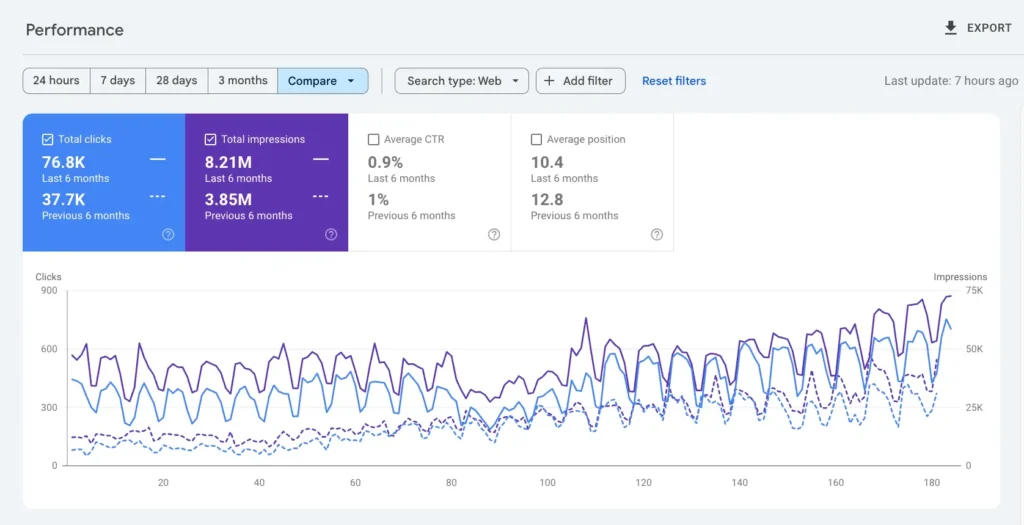
A Google Search Console comparison recorded during the 2025 SEO content campaign showed a significant increase in organic visibility:
Average CTR decreased slightly from 1% to 0.9% as the website began appearing for a broader range of keywords. Despite the wider reach, organic clicks more than doubled and average rankings improved.
This is a historical six-month comparison recorded in November 2025, not the website’s latest performance.

I stopped regular SEO and content work at the end of 2025, apart from local pages created for the second location. Organic visibility continued performing strongly afterwards.
Between 13 February and 12 August 2026, the website generated:
The clinic operated from one location when the strategy began.
It has since opened a second office, supported by dedicated local SEO pages, a new Google Business Profile and Google Ads campaigns designed to generate initial demand.
This is an important business result because the digital acquisition system could be adapted to support a new physical location rather than remaining dependent on one clinic.
It is easy to overestimate our impact and mistake correlation for causation. Based on the available data and timing of the changes, these are my best estimates of what drove the long-term growth:
Although this local SEO case study involves a clinic, the same challenge affects many businesses with a proven offer but an underperforming website.
The execution changes by industry.
A SaaS SEO strategy, for example, requires different keywords, content and attribution, but the objective remains the same: turn qualified demand into measurable growth.

Growth developed over several years. Tracking, the website redesign and local SEO created the foundation, while service pages and content steadily expanded visibility. A full year of SEO content in 2025 accelerated organic growth.
No. SEO and referrals drove the largest initial increase from 13 to 81 new patients per month. The current average of 125 includes organic search, Google Maps, referrals, Google Ads and other sources.
The strongest contributors were high-value service pages, Google Business Profile optimization, Google Reviews and consistent content. The website redesign also helped convert increased visibility into enquiries and appointments.
The brand remains anonymous because this SEO case study includes detailed information about patient acquisition, website performance and business growth.
Yes. Regular SEO and content work ended in late 2025, apart from local pages for the second location. The website still generated 127,000 organic clicks between February and August 2026.
Yes, but the execution must reflect the market and customer journey. SaaS, ecommerce and local businesses require different keywords, content, conversion paths and attribution models.