


What is a SaaS SEO audit
It answers four questions: what search engines can access, what the content actually covers, who links to it, and what happens after the click.
The deliverable is not a report. It is a decision list where every page has one assigned action.
Key Takeaways
- Sequence: Fix crawling and indexing first. Content decisions built on incomplete crawl data get reversed later.
- Pipeline over traffic: Score every page by its role in trials and demos, not by sessions.
- Cannibalization: Overlapping feature and blog pages are the most common reason SaaS revenue pages stall.
- Crawl budget: Documentation and changelog subfolders absorb crawler attention that commercial pages need.
- AI visibility: Entity clarity and schema decide whether ChatGPT, Perplexity, and Gemini can cite the product.
- Conversion layer: A page that ranks without a path to signup is a failed page, not a win.
- Prioritization: Group findings by impact and effort, then ship the low-effort, high-impact set first.
Why SaaS SEO audits are different
| Audit factor | What changes for SaaS |
|---|---|
| Buying cycle | A blog post, a comparison page, and a pricing page share credit for one signup. No single page converts alone. |
| Site size | Docs, changelogs, and help centers often outnumber marketing pages ten to one, which shifts crawl priorities. |
| Page overlap | Feature pages, use case pages, and blog posts compete for identical queries far more often than in other industries. |
| Success metric | Trials, demos, and signups replace sessions as the number that decides whether a page stays. |
When to run a SaaS SEO audit
Run a full audit when organic performance stops matching effort, or before committing budget to a new content program.
Clear triggers:
- Traffic grows while trials stay flat
- Rankings drop after a migration, redesign, or rebrand
- Several pages target one query with no obvious winner
- Competitors appear in AI answers and the product does not
- A new pricing model or ICP changes what the site should rank for
- Content output continues with no measurable pipeline contribution
For an established site, one full audit per year plus a lighter quarterly review is usually enough.
How to run a SaaS SEO audit
Before starting, collect three exports: a full site crawl, 6 to 12 months of Google Search Console data, and landing page conversions from Google Analytics.
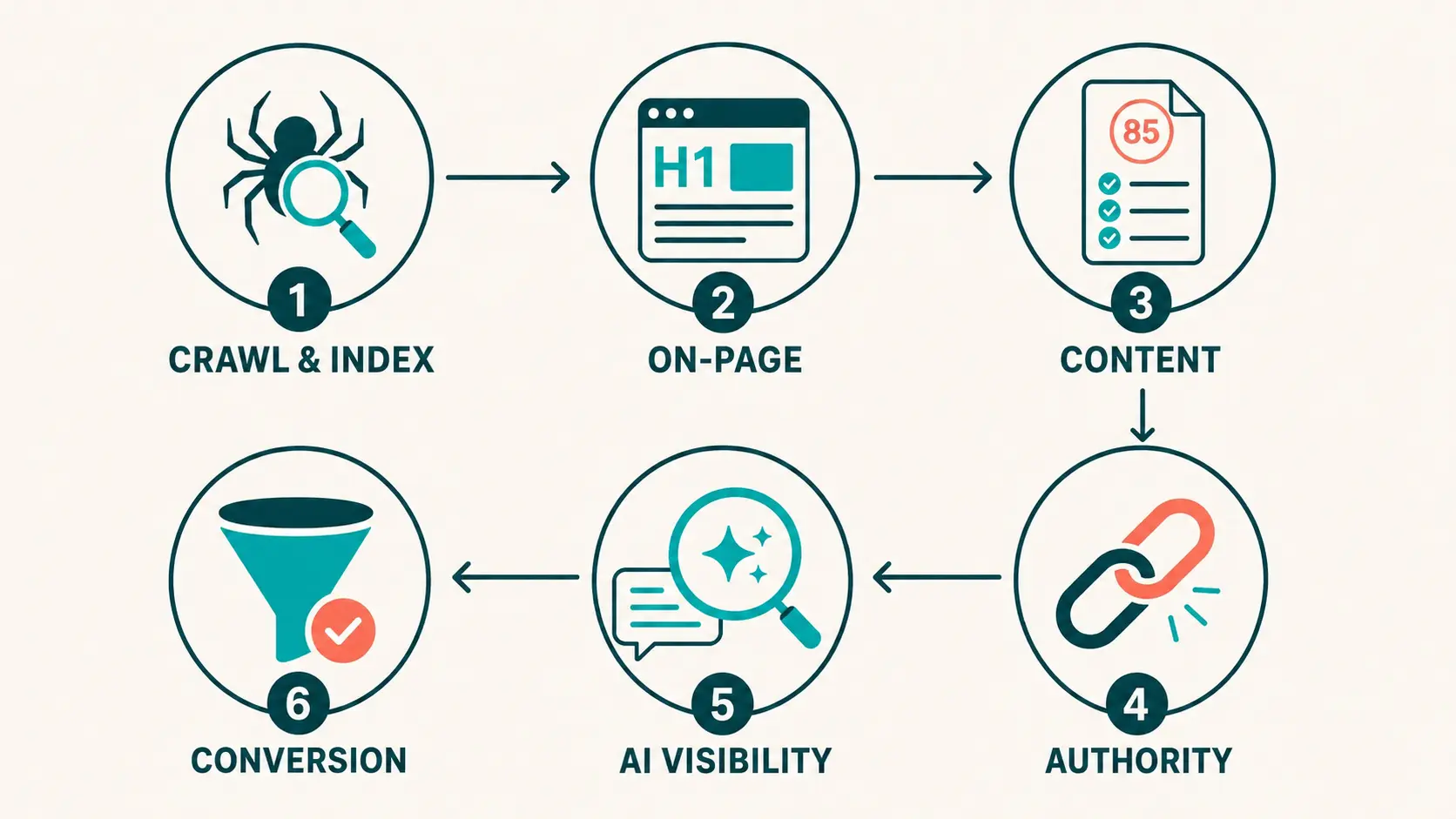
1. Crawl the site and check indexing
- Enable JavaScript rendering if the site runs on React, Vue, or Next.js
- Export indexed URLs from the Pages report and diff them against the crawl
- Open Crawl stats to see whether documentation and changelog URLs absorb most crawler attention
- Map redirect chains and canonical tags pointing somewhere unexpected
Google’s canonicalization guidance explains which signals win when your declared canonical conflicts with the detected one. Deeper fixes sit in technical SEO.
2. Audit on-page elements
Check titles and H1s for conflicting promises, duplicate metadata across templated integration pages, and heading structures that bury the value proposition below three scrolls.
Confirm structured data exists on pricing, FAQ, and product pages. Missing markup costs rich results and AI citations at the same time. Full checks in on-page SEO.
3. Score every content page
Assign each page a single action:
- Keep: ranks and converts, so protect it and add internal links
- Update: ranks without converting, usually an intent or CTA problem
- Merge: two or three URLs return for the same query across consecutive months
- Delete: no traffic, no links, no strategic role
- Redirect: no traffic, but holds backlinks worth preserving
Then map each cluster against the SaaS funnel. A cluster made only of blog posts collects readers and nothing else.
4. Map authority to priority pages
Most SaaS backlink profiles concentrate on the homepage and two blog posts, while product and comparison pages stay unsupported.
Pull referring domains rather than total links. Domains linking to two or more competitors but not to you are the most realistic targets for link building.
5. Test AI visibility
- Run category and comparison queries in ChatGPT, Perplexity, and Gemini
- Record which brands get named and which sources get cited
- Verify the product is described consistently across the homepage, feature pages, and third-party profiles
- Validate SoftwareApplication markup covering category, pricing, and operating system
- Repeat monthly, since cited sources shift faster than rankings
This is the GEO layer, covered in depth in technical GEO and ChatGPT SEO.
6. Audit the conversion path
Confirm trials and demos register as conversion events, not pageviews. Then walk the path from each ranking blog post to the relevant product page and verify it exists.
Compare signup friction against the promise made in the content. A credit card field under a free trial CTA breaks the sequence. Formats that convert are covered in content types that generate leads from AI search.
SaaS SEO audit tools
- Screaming Frog: desktop crawler with JavaScript rendering, free up to 500 URLs and licensed beyond that
- Sitebulb: crawl visualization and hreflang validation, with reports non-technical stakeholders can read
- Ahrefs or Semrush: backlink data, keyword gaps, and scheduled recurring audits
- PageSpeed Insights: Core Web Vitals from field and lab data on individual URLs
- Google Search Console: the only first-party view of index coverage and crawl behavior
For the AI layer specifically, see GEO tools.
How to prioritize audit findings
Score every finding by pipeline impact and effort, then ship the low-effort, high-impact group first.
Work the queue in this order:
- Indexation blocks: commercial pages Google cannot reach or render earn nothing until this is cleared
- Cannibalization: pick one owner for every query where two or three URLs compete
- Answer-first rewrites: pages ranking 4 to 10 move fastest on metadata and opening paragraphs
- Internal links: route traffic from high-performing content into the pages that convert
- Schema and entity work: the AI visibility layer, once the commercial pages are stable
- Link acquisition: last, and only for pages already structured to convert
Warnings on pages with no commercial role stay at the bottom, however severe the tool flags them.
Nothing kills an audit faster than a 200-item spreadsheet with no owner and no order. Attaching a value to each fix makes the sequence defensible, which the SEO ROI calculator handles.
Common SaaS SEO audit mistakes
- API-only analysis: Search Console never reveals orphaned pages, so a full crawl stays mandatory
- Static HTML crawls: a non-rendering crawl on a JavaScript site produces confident, wrong conclusions
- Uniform rules: documentation and marketing pages need different indexation standards
- Severity over revenue: a critical warning on a page nobody buys from is a low priority
- No implementation path: findings without owners and deadlines never ship
- Skipping AI visibility: absence from generative answers appears in no classic report
How much does a SaaS SEO audit cost
Published pricing guides put most professional SEO audits between $500 and $5,000. SaaS sites sit toward the upper end, because documentation volume and multi-market setups expand scope.
Typical market ranges:
- Automated reports: under $500. Tool output with no human prioritization. A pulse check, not a roadmap.
- Basic technical audit: $500 to $1,500. Crawl, indexation, and on-page checks on a small single-market site.
- Standard professional audit: $1,500 to $5,000. Manual review, content scoring, competitor comparison, and a prioritized action list. Most companies land here.
- Enterprise audit: $10,000 and above. Log-file analysis and large-scale JavaScript crawling on sites with hundreds of thousands of URLs.
My audit is free and included in every package. It is how I scope the work, so it runs before any quote, and you keep the findings either way.
Book a free audit call and I will review your index coverage and AI visibility before we speak.
FAQs about SaaS SEO Audit
How long does a SaaS SEO audit take?
2 to 3 weeks for most SaaS sites. Crawling and data collection take a few days, analysis takes the bulk of the time, and prioritization takes the rest. Sites with multiple markets or heavy documentation portals can extend this to four weeks.
Can a SaaS site be audited without analytics access?
Partially. Crawl data, on-page analysis, backlinks, and AI visibility can all be assessed externally. Without Search Console and GA4, the content and conversion steps become guesswork, because there is no way to see which pages actually produce trials.
What is the difference between an SEO audit and a GEO audit?
An SEO audit measures how a site performs in Google search results. A GEO audit measures whether generative engines can identify, understand, and cite the brand. They overlap on schema and structure, but diverge on entity consistency and citation tracking. GEO vs SEO covers the split.
Should the audit cover the product app or only the marketing site?
Both, with different objectives. The marketing site is audited for rankings and conversions. The application and documentation are audited mainly for crawl control, deciding what deserves indexing as a content asset and what should be blocked to protect crawl budget.
Is a free SEO audit tool enough for a SaaS site?
For a site under a few hundred pages, free tiers of Search Console and a desktop crawler cover the technical layer well. They do not cover backlink gaps, competitor comparison, or AI citation tracking, which is where paid data becomes necessary.
How often should a SaaS company run an SEO audit?
Once a year for a full audit, with a lighter quarterly review covering index coverage, cannibalization, and conversion tracking. Run an unscheduled audit immediately after any migration, redesign, or significant drop in rankings or signups.
