


What knowledge graph SEO means
Knowledge graph SEO is the practice of making the entities, attributes, and relationships in your website clear to search engines and AI systems.
Instead of treating a page as a bag of keywords, you connect concepts such as your business, services, audience, authors, locations, and evidence. The goal is entity clarity, not keyword repetition.
Google describes its Knowledge Graph as a way to find entities through a read-only API. Your SEO work cannot edit Google’s database directly, but it can make your own signals easier to interpret (Google Knowledge Graph Search API).
Google’s Knowledge Graph versus your content graph
These ideas are related but not interchangeable. Google’s Knowledge Graph is Google’s database, while your content graph is the network expressed across your site. The distinction prevents unrealistic promises about Knowledge Panels.
| Google’s Knowledge Graph | Your content graph |
|---|---|
| Google-managed database of people, places, companies, and concepts. | Site-level map of entities your pages define and support. |
| Queried through Google’s read-only Knowledge Graph Search API. | Built through architecture, links, language, and structured data. |
| May influence entity experiences when Google has enough confidence. | Helps crawlers and AI systems interpret topics and relationships. |
| Cannot be edited by adding a field to your website. | Improved by correcting ambiguity and strengthening evidence. |
The connection is signal alignment. Name each entity consistently in copy and schema.
Why knowledge graphs matter for SEO
Knowledge graph SEO matters because search systems need to understand what a page refers to before they can match it to a query or answer.
Google says structured data provides explicit clues about page meaning and can help it gather information about people, books, and companies (Google structured data introduction). Entity clarity also helps AI systems connect content, although markup guarantees neither rankings nor citations.
The benefits are practical:
- Disambiguation: clarify whether a name refers to a company, person, product, place, or concept.
- Context: show which services and audiences belong together.
- Architecture: turn isolated articles into a connected topical system.
The result is better machine understanding, not a shortcut around useful content, access, relevance, or authority.
How to build a knowledge graph SEO system
A useful graph begins with ownership decisions, then moves into implementation and quality control. The sequence ties the graph to pages and evidence for your site and team.
It gives your team a repeatable way to improve clarity over time.
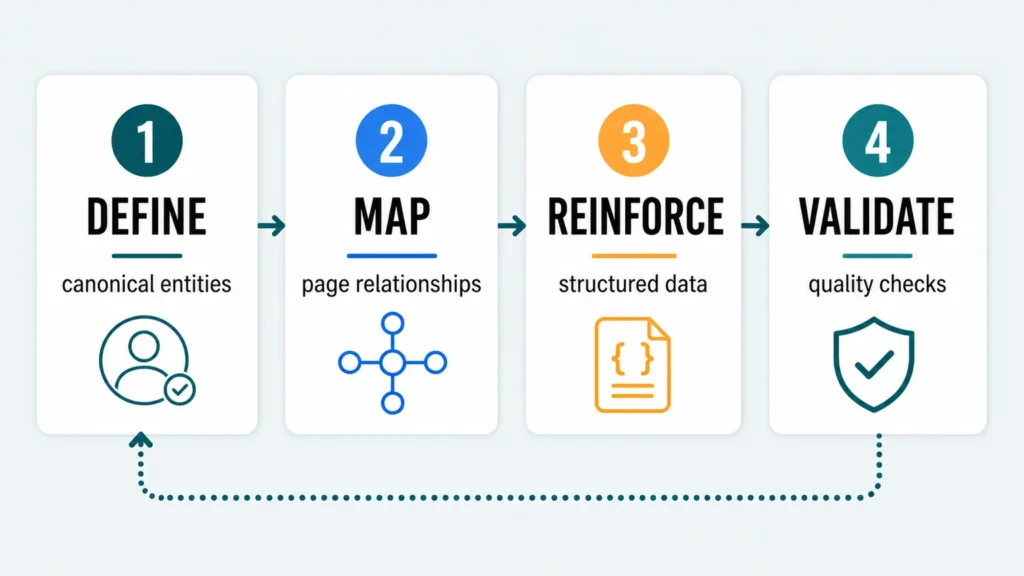
1. Define the entities your site owns
Start with the entities your site should be known for: the organization, people, products, services, locations, audiences, and core concepts.
Give each priority entity a canonical name, short definition, owning URL, and supporting pages. Record aliases only when customers or authoritative sources use them. One canonical owner reduces fragmentation.
Do not create an entity merely because a keyword exists. An entity needs stable meaning and a reason to exist in your site model.
2. Map relationships across pages
Connect each entity to pages that define, support, compare, or qualify it. Record the relationship, not only the link.
Use descriptive internal links. “Technical GEO services” tells a clearer story than “learn more” and expresses a meaningful edge between topical nodes.
For a large inventory, use a structured export rather than pasting hundreds of rows into an AI prompt.
Audit the attached site inventory as an entity and relationship map for [WEBSITE]. Use only the supplied rows and the manual context below. Identify each page’s primary entity, related entities, canonical owner, missing relationships, duplicate entity names, orphan pages, and inconsistent terminology. Preserve row-level evidence by citing the relevant URL and source column for every finding. Separate observed facts from recommendations. If required columns are missing, stop and list them. Do not invent entities, metrics, URLs, or relationships.

UPLOAD

FILE = CSV or XLSX site inventory export

REQUIRED COLUMNS = URL, page title, primary topic or entity, related entities, schema types, internal links

INPUTS

WEBSITE =

BUSINESS DESCRIPTION =

AUDIENCE =

PRIMARY MARKET =
3. Reinforce entities with structured data
Choose schema types that accurately describe visible page content, then connect related nodes with stable identifiers where appropriate. Schema.org defines `sameAs` as a URL for a reference page that unambiguously identifies an item, such as an official site, Wikipedia page, or Wikidata entry (Schema.org sameAs).
Use `@id` consistently when your implementation needs to refer to the same organization, person, or webpage across connected JSON-LD objects. Keep the markup aligned with what users can see. Structured data clarifies meaning; it does not manufacture authority.
4. Validate the graph
Test structured data, review canonical ownership, and recheck important relationships after redesigns or content migrations. Google’s guidance says markup must represent visible content, follow quality policies, and does not guarantee a rich result (Google general structured data guidelines).
Keep a change log for renamed entities, redirected URLs, replaced authors, and removed services. A maintained graph reflects the current site, not an idealized version that no longer exists.
How to use schema for entity clarity
Schema makes a clear page easier for machines to classify. It is not a substitute for visible naming or independent evidence.
Use the most specific type and connect it to the page. Google’s gallery shows which markup types can make pages eligible for search features (Google Search Central structured data gallery).
Use this implementation order:
- Match the type: select Organization, Person, Article, Product, Service, or another type because it fits the page.
- Connect identities: use stable `@id` values and verified `sameAs` references.
- Reflect visibility: mark up information readers can find on the page.
Avoid adding every possible property. Relevant markup is stronger than decorative markup that describes content the page does not contain.
How internal links strengthen entity relationships
Internal links turn your entity model into a crawlable site structure. They show which page owns a concept and how supporting pages relate to it. Descriptive links make relationships inspectable.
Prioritize these actions:
- Connect every supporting page to its canonical entity owner.
- Point the owner to the most useful supporting evidence.
- Add lateral links when two entities have a meaningful relationship.
- Review orphan pages and links whose labels no longer match the destination.
Internal links do not force a search engine to accept your ontology. They create evidence evaluated alongside content, crawlability, external references, and user needs.
How to measure knowledge graph SEO
Measure whether the site is becoming clearer and more visible, rather than treating a Knowledge Panel as the only success signal.
| Measurement layer | What to inspect |
|---|---|
| Entity consistency | Names, descriptions, authors, services, and locations match across key pages and profiles. |
| Graph coverage | Priority entities have an owner URL, supporting pages, links, and accurate schema. |
| Technical integrity | Crawlers access canonical pages, schema validates, and redirects preserve relationships. |
| Search visibility | Search Console shows impressions, queries, rich-result eligibility, or stronger topical visibility. |
| AI visibility | Tests show whether ChatGPT, Gemini, or Perplexity understand the intended entity. |
Use audits to track corrected ambiguity, new connections, and broken relationships. Visibility is an outcome to observe, not proof that one field caused a ranking or citation change.
Common knowledge graph SEO mistakes
Most failures come from treating the graph as markup alone:
- Keyword-only planning: grouping pages by similar wording without checking whether they describe the same entity or intent.
- Duplicate ownership: publishing several pages that appear to define the same concept without assigning a canonical owner.
- Schema overreach: marking up unsupported, hidden, or irrelevant information.
- Unverified identities: linking `sameAs` to a profile that belongs to a different person, brand, or organization.
- Generic anchors: using vague internal-link labels that hide the relationship between pages.
- Static graphs: failing to update entity names, URLs, authors, offers, or relationships after site changes.
- Guaranteed outcomes: promising a Knowledge Panel, higher rankings, or AI citations from entity work alone.
Fix the model first, then implementation. Accuracy beats scale.
