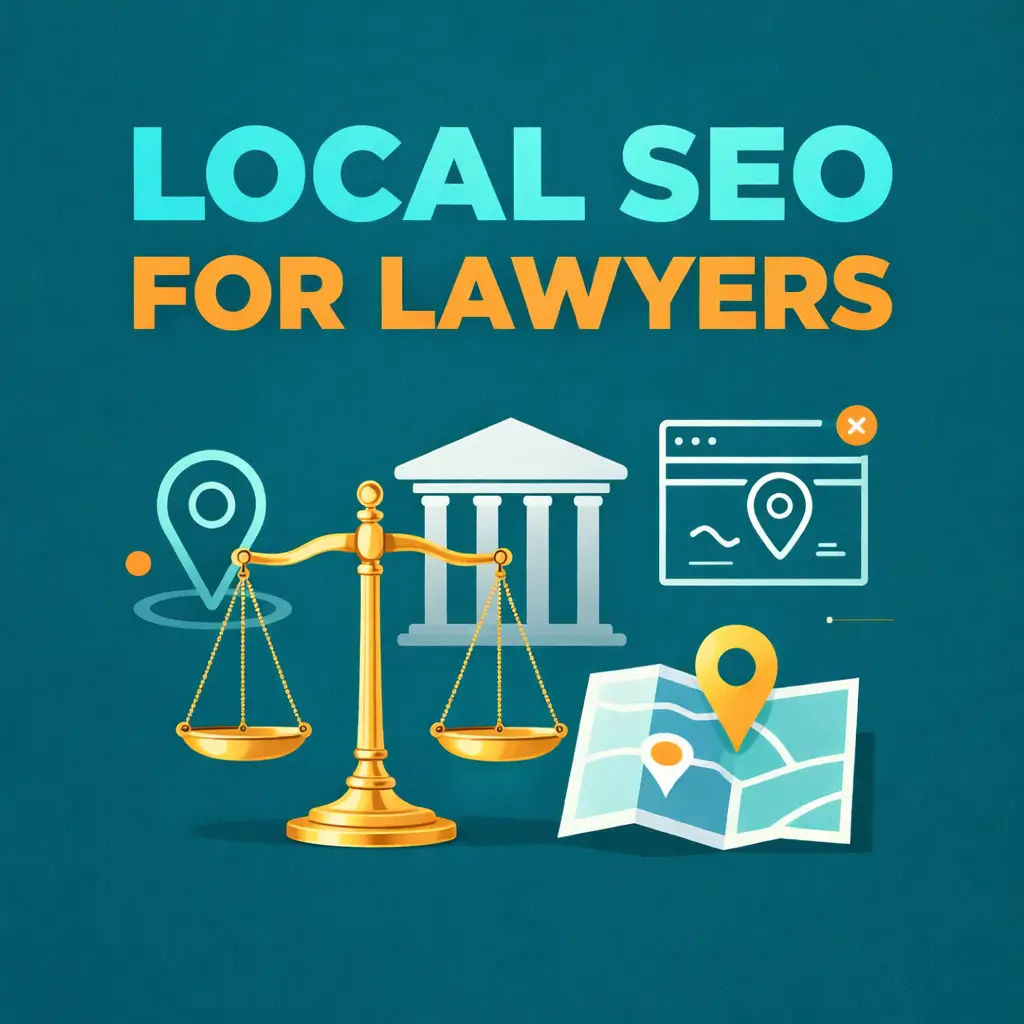
Many law firms have grown through referrals, networking, and reputation alone. Local SEO for lawyers does not replace that foundation. It strengthens it.
In 2026, even referred clients verify before calling.
They search your firm’s name, read Google reviews, compare nearby competitors, and often check online summaries before making contact. Word of mouth may start the process — but search frequently influences the final decision.
Local SEO for lawyers ensures that when someone looks you up, they find clarity and credibility. It aligns your Google presence, practice areas, reviews, and local visibility so your reputation holds up online.
It is not a necessity to survive.
But in competitive legal markets, it is a clear advantage.
What Is Local SEO for Lawyers?
Local SEO for lawyers is the process of making a law firm visible in Google Maps and local search results when someone searches for legal help in a specific area.
Unlike general local SEO, legal search is highly competitive and high-stakes. Clients are not casually browsing. They are often dealing with urgent or expensive problems and comparing multiple firms before making contact.
The structure is similar in principle, but the level of competition and trust required is different.
| General Local SEO | Local SEO for Lawyers |
|---|---|
| “Service + city” searches | “Practice area + city” searches |
| Moderate competition | Extremely high competition |
| Reviews improve rankings | Reviews strongly influence decisions |
| Basic service pages | Dedicated practice-area + location pages |
| Standard trust signals | Strong authority and credibility needed |
For law firms, local SEO is not just about ranking. It is about ranking with authority.
Why Local SEO Matters for Lawyers
Legal searches are different from most local services.
When someone searches for a lawyer, the intent is usually urgent and high-stakes.
- 96% of potential clients use search engines during their legal research.
- 75% never go past page one.
- 76% of local searches lead to a call or visit within 24 hours.
- 60% of smartphone users call directly from Google results.
(Source: https://growlaw.co/seo-for-lawyers/legal-seo-statistics)
For law firms, local SEO is not just traffic. It is decision-stage visibility — where ranking in the top results often determines who gets the consultation.
How Potential Clients Search for Lawyers in 2026
Legal searches are no longer linear.
Clients research, compare, and verify before making contact.
| Search Behavior | What It Signals |
|---|---|
| “Divorce lawyer near me” | Immediate, high-intent need |
| “Best criminal lawyer in [city]” | Comparison between top results |
| Direct search of firm name | Referral verification |
| Reading Google Maps reviews | Trust validation |
| Checking 2–3 competing firms | Shortlist decision stage |
| Asking AI tools for recommendations | Multi-source confirmation |
| Searching “free consultation lawyer” | Price sensitivity + urgency |
In 2026, law firm selection is rarely impulsive.
The firms visible across these moments are the ones that get contacted.
How Google Ranks Law Firms in Local Search
Google ranks law firms in local results based on three primary factors: Relevance, Distance, and Prominence.
- Relevance – How closely your practice areas match the search (e.g., “family lawyer Rome”). Clear categories, optimized practice pages, and detailed services improve this.
- Distance – How physically close your office is to the searcher or the city used in the query.
- Prominence – Your overall authority. This includes review volume and quality, backlinks, citations, brand mentions, and website strength.
For lawyers, prominence often becomes the differentiator, especially in competitive cities where many firms share similar locations and services.
1. Relevance
Relevance measures how closely your law firm matches what someone is searching for.
Google analyzes your Google Business Profile, website content, and service descriptions to understand your specialties. If someone searches for “immigration lawyer Milan,” Google looks for clear signals that you handle immigration law — not just generic “legal services.”
Key factors that improve relevance:
- Clearly defined practice areas
- Optimized practice-area + city pages
- Accurate Google Business Profile categories
- Detailed service descriptions
- Consistent legal terminology across your site
For law firms, vague positioning reduces visibility. Specific practice signals increase your chances of appearing in high-intent searches.
2. Distance
Distance refers to how close your law firm is to the person searching — or to the city used in the query.
If someone types “criminal lawyer near me,” Google prioritizes firms physically located near that user. If they search “divorce lawyer Rome,” Google evaluates which firms are actually based in Rome.
Key factors that influence distance:
- Verified office address in your Google Business Profile
- Consistent NAP (Name, Address, Phone) across directories
- Location-specific practice pages
- Proximity to the searcher’s device location
Distance cannot be manipulated easily. But for multi-location firms, structured location pages and properly set profiles help maximize visibility in each target area.
3. Prominence
Prominence reflects how established and trusted your law firm appears online.
When multiple firms are equally relevant and similarly located, prominence often determines who ranks higher.
Google evaluates signals such as:
- Number and quality of Google reviews
- Overall review rating and response activity
- Backlinks from reputable websites
- Mentions in legal directories
- Media coverage and brand searches
- Website authority and content depth
For law firms, prominence is critical. Legal services involve trust, risk, and financial impact.
Firms with stronger digital authority and visible proof tend to rank higher — and receive more inquiries.
Google Business Profile Optimization for Lawyers
Your Google Business Profile (GBP) is often the first impression a potential client sees. In many cases, they call directly from the map results without visiting your website.
For law firms, optimization is not cosmetic. It directly affects visibility and trust.
Key areas to optimize:
- Primary category – Choose the most accurate practice area.
- Secondary categories – Add relevant specializations without dilution.
- Services section – List detailed practice areas clearly.
- Reviews – Generate consistent feedback and respond professionally.
- Photos – Real office and team images build credibility.
- Posts & updates – Publish helpful, relevant firm updates.
If you want a deeper breakdown of the process, you can review the full approach on the Local SEO Services page: https://tommasoliu.com/local-seo-services/
1. Categories and services
Your Google Business Profile categories tell Google exactly what type of law you practice. The wrong category limits visibility, even if your website is optimized.
| Element | Examples for Law Firms |
|---|---|
| Primary Category | Criminal Defense Attorney, Personal Injury Attorney, Family Law Attorney, Immigration Attorney |
| Secondary Categories | DUI Lawyer, Divorce Lawyer, Trial Attorney, Estate Planning Attorney |
| Avoid | Generic “Lawyer” if you specialize, or unrelated categories like Notary Public (unless core service) |
| Service Listings | “DUI Defense,” “Child Custody Representation,” “Car Accident Claims,” “Work Visa Assistance” |
| Alignment | Each listed service should match a dedicated practice-area page on your website |
For lawyers, specificity increases both relevance and case-quality inquiries.
2. Reviews and Reputation
For law firms, reviews are not just ranking signals — they are decision drivers. In competitive cities, review strength often determines who gets contacted.
| Element | What Law Firms Should Do |
|---|---|
| Review Volume | Consistently request reviews from satisfied clients (ethically and within bar guidelines). |
| Review Quality | Encourage detailed feedback mentioning practice area and experience. |
| Response Activity | Reply professionally to every review to show engagement. |
| Recency | Maintain steady review flow, not large gaps. |
| Star Rating | Aim for 4.5+ while prioritizing authenticity over perfection. |
Firms with stronger, recent, and practice-specific reviews tend to rank better and convert more inquiries.
Ethical Considerations When Asking for Reviews
Law firms must follow professional conduct and consumer protection rules when requesting reviews.
- Reviews must be voluntary.
- Do not offer money, gifts, or discounts in exchange.
- Avoid language that creates unjustified expectations.
- Never fabricate or edit client testimonials.
- Respect confidentiality and data protection laws (e.g., GDPR in Europe).
In most jurisdictions, politely asking satisfied clients for feedback is allowed.
Manipulation or incentives are not.
3. Photos and updates
| Element | Best Practice for Law Firms |
|---|---|
| Office Photos | Show exterior signage, reception area, meeting rooms. |
| Team Photos | Professional but approachable images of attorneys and staff. |
| Branded Images | Logo consistency across profile and website. |
| Google Posts | Share legal tips, firm updates, case milestones (without confidential details). |
| Posting Frequency | Update at least monthly to signal activity. |
Website Strategy for Local SEO for Lawyers
Your website reinforces your local rankings by providing structure, clarity, and authority.
At a strategic level, focus on:
- Practice area + city pages – Create targeted pages like “Personal Injury Lawyer Chicago” or “Divorce Attorney Madrid” for competitive markets.
- Multi-location structure – If you have multiple offices, build a dedicated page for each location with unique content and clear contact details.
- Strong on-page foundations – Clear headings, internal linking between related services, consistent NAP information, fast mobile performance, and visible trust elements (bios, credentials, testimonials).
Local SEO for lawyers is not just about one homepage.
It is about a structured, location-aware content architecture.
Practice area + city pages
Practice area + city pages target high-intent searches like “car accident lawyer Dallas” or “divorce attorney Barcelona.” In competitive markets, these pages are often necessary to rank. Best practices:
- Create one page per core practice area + primary city (not every small town unless justified).
- Write unique content for each page. Avoid copying the same text and swapping city names.
- Include local references: courthouse names, neighborhoods, or jurisdiction details.
- Add attorney bios relevant to that practice area.
- Embed a Google Map and display consistent NAP information.
- Link internally from related practice pages.
Well-structured location pages increase relevance and improve visibility for high-value legal queries.
Multi-location law firms
For firms with multiple offices, structure matters more than volume. Google needs to clearly understand each office as a distinct local entity.
Effective strategies include:
- Create a dedicated page for each office, with unique contact details, attorney bios, and localized content.
- Add a structured “Locations” hub page linking to every office.
- Include location links in the footer navigation for consistent internal linking.
- Display the correct NAP and embed the specific Google Map for each office page.
- Use structured data (LocalBusiness schema) per location.
You can use a standardized template for scalability. However, avoid pure copy-paste. Core structure can stay consistent, but intro text, local references, and team details should be customized to prevent thin or duplicate content issues.
On-page signals that matter
Beyond structure, certain on-page elements consistently influence local rankings and conversions. Focus on clarity and alignment:
- Use one clear H1 reflecting the main query (e.g., “Criminal Defense Lawyer in Austin”).
- Structure content with logical H2/H3 sections for readability and crawlability.
- Maintain consistent Name, Address, Phone (NAP) across the page.
- Add internal links to related practice areas and relevant blog content.
- Optimize title tags and meta descriptions for city + practice combinations.
- Include trust indicators: bar admissions, case types handled, years of experience.
- Ensure fast load speed and full mobile responsiveness.
For law firms, clean structure and semantic clarity often outperform over-optimized keyword stuffing.
Local Citations and Legal Directories
Local citations are online mentions of your firm’s name, address, and phone number (NAP). Legal directories are platforms where lawyers create structured public profiles with their practice areas, credentials, and contact details.
To build citations:
- Claim and update your profile in your official bar directory.
- Search Google for: “top lawyer directories in [your country].”
- Look at where top-ranking competitors are listed.
- Register, complete your profile fully, and keep NAP details identical everywhere.
- Avoid low-quality or irrelevant directories. Focus on legal-specific platforms.
Official Bar Directories
| Country | Official Directory |
|---|---|
| United States | https://www.americanbar.org |
| United Kingdom | https://solicitors.lawsociety.org.uk |
| Italy | https://www.consiglionazionaleforense.it |
| Spain | https://www.abogacia.es |
| Germany | https://www.brak.de |
Major Legal & Local Directories
| Country | Key Legal Directories |
|---|---|
| United States | https://www.avvo.com · https://www.justia.com · https://www.martindale.com · https://www.findlaw.com |
| United Kingdom | https://www.solicitors.com · https://www.legal500.com |
| Italy | https://www.paginegialle.it · https://www.avvocato360.it |
| Spain | https://www.paginasamarillas.es · https://www.lawyerdirectory.es |
| Germany | https://www.anwalt.de · https://www.juraforum.de |
Supporting Strategies Beyond Local SEO
Local SEO captures search demand. These two strategies expand reach and accelerate growth:
- Content Creation – Blog articles, videos, and social posts that build authority, educate potential clients, and reinforce trust before consultations.
- Google Ads – Paid search campaigns targeting high-intent keywords to generate immediate visibility while SEO compounds over time.
Content Strategy for Law Firms Targeting Local Clients
Blog content remains the foundation of a strong legal marketing strategy.
From there, authority can expand across search, social media, and video, turning one well-structured article into multiple visibility and trust-building assets that support both organic growth
Lawyers Doing This Well
| Lawyer | Profile |
|---|---|
| Mike Mandell (US) | https://www.tiktok.com/@lawbymike |
| Jeffrey Reisman (US) | https://www.youtube.com/@ReismanLaw |
| Avv. Angelo Greco (Italy) | https://www.youtube.com/@AngeloGreco |
| Avv. Cataldo Calabretta (Italy) | https://www.instagram.com/cataldocalabretta |
These lawyers simplify legal topics, answer real client questions, and build visibility beyond traditional referrals.
A Simple Content Workflow
- Write a structured article (SEO-optimized).
- Record a 10–20 minute YouTube video explaining the topic conversationally.
- Chop the video into:
- 3–6 short clips (Reels / Shorts)
- Quote-style posts (X/Twitter)
- FAQ snippets
- Embed the full video inside the blog article.
- Link both to relevant practice pages.
Google Ads for Immediate Visibility
While SEO builds long-term authority, Google Ads provide immediate exposure for high-intent searches such as “personal injury lawyer near me” or “DUI attorney free consultation.”
For law firms, paid search can:
- Appear above organic results instantly
- Target specific practice areas and cities
- Generate consultations while SEO compounds
- Test which keywords convert before investing in long-term content
In competitive legal markets, ads are not a replacement for SEO. They are a strategic accelerator — especially for new firms or highly competitive practice areas.
Common Mistakes in Local SEO for Lawyers
Many law firms lose visibility due to small but critical inconsistencies.
Common issues include:
- Using a generic “Lawyer” category instead of a specific primary practice area.
- Creating thin location pages with copied text and only the city name changed.
- Inconsistent Name, Address, Phone (NAP) across platforms.
- Ignoring reviews or failing to request them consistently.
- Overusing keywords instead of writing clearly for clients.
- Neglecting mobile speed and technical performance.
Example of a NAP issue:
- Website: Smith & Johnson Law Firm – 120 Main Street, Suite 400, Dallas, TX 75201 – (214) 555-0182
- Google Profile: Smith and Johnson Attorneys – 120 Main St #400 – 214-555-0182
Even small differences in business name, address formatting, or phone number structure can weaken local ranking signals. Consistency builds trust.
When to Hire Help for Local SEO for Lawyers
Some firms can manage basic optimization internally. But local SEO becomes complex when competition increases or results plateau.
It may be time to bring in an expert when:
- Rankings are stuck despite publishing content.
- Competitors dominate the local map results.
- Reviews are strong, but visibility remains low.
- Multiple locations require structured coordination.
- There is no clear strategy linking website, GBP, and content.
Local SEO for lawyers is not just technical setup. It requires structured architecture, competitive analysis, and ongoing refinement.
For firms that want predictable growth instead of experimentation, working with a specialist ensures strategy, consistency, and measurable results.
FAQs About Local SEO for Lawyers
How long does local SEO take for law firms?
In competitive legal markets, meaningful movement often takes 3–6 months. Highly competitive cities may require longer, especially for top 3 map positions.
Do lawyers need separate pages for each city?
Is Google Business Profile more important than the website?
Can small law firms compete with large firms?
Is SEO better than Google Ads for lawyers?
SEO builds long-term equity. Ads provide immediate visibility. The strongest firms often use both strategically.