Google Ads for Dentists: The Complete 2026 Guide
What do you want from Dental Google Ads?
Table of Contents
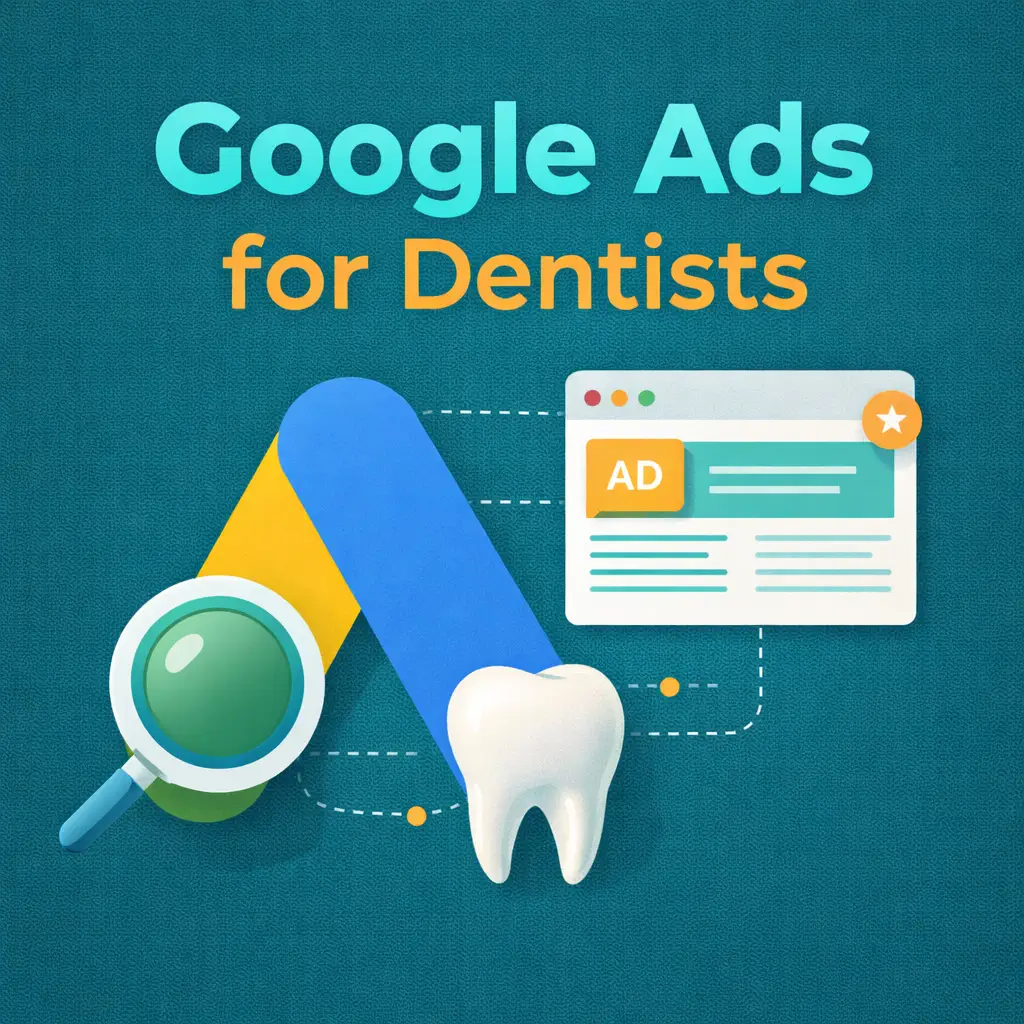
Should Dentists Invest in Google Ads in 2026?
In 2026, Google Ads still work for dentists — if the math works.
Competition is higher and clicks are not cheap.
But this is not about “trying ads.” It’s about reverse-engineering profitability.
If the numbers make sense, Google Ads can quickly become a predictable patient acquisition channel.
When Google Ads for Dentists Make Strategic Sense
Google Ads make sense when your clinic can turn online searches into real appointments — not just website visits. They work best when:
- You have empty chair time and want more bookings
- You offer treatments with strong revenue per case (implants, aligners, full-mouth cases)
- You’re opening or growing a second location
- Patients who visit your site usually end up calling or booking
- You can clearly see how many calls or requests come from ads
- You know roughly how much a new patient is worth to your clinic
If your clinic can handle more patients and measure results clearly, Google Ads can become a predictable way to grow — not a gamble.
How to Check If Your Google Ads Are Truly Profitable
You can estimate the numbers before launching Google Ads.
But you only know the truth after real data.
Clicks, conversion rates, and close rates are never exactly what you expect.
That’s why testing is necessary.
Once you have real numbers, you only need to answer three simple questions to see if your ads are actually profitable.
1. How Much Does One New Patient Cost You?
- How much did you spend on ads?
- How many actual patients started treatment from the Ads?
- How much did you pay your Google Ads specialist or agency?
Add Ad spend + management fee together, then divide by new patients.
(Ad Spend + Agency Fee) ÷ New Patients = Real Cost per New Patient
Example:
- $3,000 ad spend
- $1,000 agency fee
- 2 new patients
- ($3,000 + $1,000) ÷ 2 = $2,000 per new patient
That’s your real acquisition cost.
Step 2. How Much Do You Actually Keep From the Treatment?
- What is the treatment fee?
- What is your real profit margin after lab, materials, staff, rent, delegated work?
Treatment Fee × Profit Margin = Real Profit Per Case
Example:
- Implant fee: $4,000
- Real profit margin: 30%
- $4,000 × 30% = $1,200 real profit per case
Not $4,000.
Step 3. Subtract and See the Truth
Real Profit Per Case − Real Cost per New Patient = Net Profit After Ads
If positive → scalable.
If small → risky.
If negative → you’re paying to work.
Example:
- Real profit per implant: $1,200
- Real cost to acquire patient: $2,000
- $1,200 − $2,000 = –$800
You generated revenue.
But you lost money.
Google Ads ROI Calculator
Simple Google Ads ROI Check
Do you keep profit after ads?
Type your numbers. Results update automatically.
Your numbers
Results
Cost per new patient
$0
Profit you keep per case
$0
Profit after ads (per patient)
$0
Enter your numbers to see if ads leave real profit.
Show how it’s calculated
- Cost per new patient = (Ads spend + Fee) ÷ New patients
- Profit per case = Treatment fee × Margin
- Profit after ads = Profit per case − Cost per new patient
How Much Budget Do You Actually Need?
Google Ads budget depends mainly on keyword cost and realistic conversion rates.
| Keyword Type | Typical CPC → Realistic Monthly Budget Range |
|---|---|
| Local “dentist near me” or “dentist brooklyn” | $6–$12 per click → $1,500–$2,500/month |
| General dentist services | $8–$15 per click → $2,000–$3,500/month |
| Emergency dentist | $12–$25 per click → $2,500–$4,500/month |
| Invisalign / clear aligners | $15–$30 per click → $3,000–$5,000/month |
| Dental implants | $18–$35 per click → $4,000–$6,000+/month |
These budgets assume:
- 3–6% website conversion rate
- 15–25% close rate
- Enough volume (150–300 clicks/month) to generate usable data
Below these ranges, campaigns often generate too few leads to optimize properly — results feel random rather than stable.
Are There Better Alternatives to Google Ads for Dentists Right Now?
Google Ads for dentists can drive fast traffic — but they’re not always the smartest first move.
In many clinics, strengthening your base first produces more stable growth.
You may want to prioritize:
- Local SEO for dentists — long-term visibility in Google Search and Maps without paying per click
- Dental email marketing — reactivating past patients at minimal cost
- Word of mouth and referral systems — often the highest-converting source
- Social media for dentists — builds trust before patients even search
- Improving your website conversion rate — makes every channel more profitable
Google Ads amplify what already works.
Fix the foundation first. Then scale with paid traffic.
That’s exactly what we did in this case → See how SEO + ads worked structured together.
Hiring a Google Ads Agency / Specialist
What Do Google Ads Services for Dentists Include?
Professional Google Ads management for dentists covers the full process — from research and setup to tracking, optimization, and reporting. Here is what’s usually included.
Keyword Research
Identifying high-intent dental keywords such as “dental implants near me” or “emergency dentist,” while filtering out low-quality or irrelevant searches that waste budget.
Campaign Structure
Organizing campaigns by treatment type (implants, Invisalign, emergency, general dentistry) so budget and performance can be controlled separately.
Ad Copywriting
Writing headlines and descriptions that clearly mention the treatment, location, and trust signals to increase click-through rate and lead quality.
Conversion Tracking Setup
Installing proper tracking for phone calls, form submissions, and key actions so real performance can be measured.
Call Tracking (If Needed)
Tracking phone calls from ads separately to understand which campaigns generate actual consultations.
Landing Page Creation or Guidance
Recommending or improving landing pages so traffic doesn’t get sent to a generic homepage that lowers conversion rates.
Ongoing Optimization
Reviewing search terms, adding negative keywords, adjusting bids, testing ads, and reallocating budget weekly or biweekly.
Reporting & Performance Review
Providing clear reports focused on leads, cost per patient, and profitability — not just clicks and impressions.
How Much Does Google Ads Management Cost?
Google Ads costs include 2 separate things: the ad budget and the management fee.
Many dentists confuse them.
Ad Budget: The money paid directly to Google.
This depends on your city and treatments.
In competitive markets:
- General dentistry: $1,500–$3,000/month
- Invisalign: $3,000–$5,000/month
- Dental implants: $4,000–$6,000+/month
Lower budgets usually mean slower learning and inconsistent results.
Management Fee: What you pay the specialist or agency.
Common models:
- Flat monthly fee (often $800–$2,000+)
- Percentage of ad spend (10–20%)
- Hybrid (base fee + performance component)
Cheap management often leads to wasted clicks.
Good management protects your margin.
The real question is not “How much does it cost?”
It’s: “Does the math leave profit after ads and management?”
That’s what determines whether scaling makes sense.
How to Avoid Costly Mistakes When Hiring
Hiring the wrong Google Ads agency doesn’t just waste money — it can lock you into a fragile system.
| Warning Sign | Why It Can Be a Problem |
|---|---|
| They talk only about clicks and impressions | Traffic does not equal patients. Without cost per patient and profitability discussion, you don’t know if it works. |
| No proper call or form tracking | If consultations aren’t tracked, you can’t measure real performance or improve it. |
| You don’t control or have access to the ad account | If the agency owns everything, you may lose historical data and performance insights if you stop working together. |
| “Set and forget” approach | Google Ads require weekly optimization. Without it, costs rise and lead quality drops. |
| No realistic budget discussion | If they promise results with very low budgets in competitive markets, expectations may not match reality. |
| Reports avoid profit conversations | If margin and cost per patient aren’t discussed, you carry the financial risk. |
| Large upfront payment that mixes ad spend and management fee | You may not know how much is actually going to Google vs. the agency. Lack of transparency makes it hard to evaluate performance or stop safely. |
A serious agency protects your data, tracks real outcomes, and talks about profitability — not just traffic.
Before hiring anyone (including me), look at the receipts.
Questions to Ask Before Hiring
Before hiring a Google Ads specialist, ask questions that protect your clinic’s profit — not just your traffic.
- How do you calculate the real cost per new patient?
- What metrics do you track and report every month?
- How often do you adjust keywords, ads, and targeting based on performance?
- What signals tell you a campaign needs changes?
- What budget do you realistically recommend for my city and treatments?
- Will I have full access to my Google Ads account and historical data?
- How do you define success for a dental clinic?
Clear, structured answers show process and accountability.
Vague answers usually mean guesswork.
How to Run Google Ads for Dentists Yourself
How Google Ads Work (Simple Explanation)
Google Ads work like an instant auction that happens every time someone searches.
Here’s what happens:
- A patient searches for something like “Dentist near me.”
- Google looks at all advertisers targeting that keyword.
- An automatic auction decides which ads appear and in what order.
- If someone clicks your ad, you pay.
- If they don’t click, you don’t pay.
You’re not paying to show up.
You’re paying for someone who is actively interested enough to click.
The better your ad and landing page match the search, the more efficiently your budget works.
Where Your Dental Ads Can Appear
Google Ads are not just “search ads.” Your clinic can appear in different places across Google’s network.
| Ad Type / Placement | When It Makes Sense for Dentists |
|---|---|
| Google Search Ads | Best starting point. Shows when someone searches for treatments like “dental implants near me.” High intent. |
| Google Maps Ads | Useful in competitive cities. Helps appear above other local clinics in map results. |
| Performance Max (PMax) | Combines search, Maps, YouTube, and display. Better once you have solid tracking data. |
| YouTube Ads | Good for explaining treatments or building trust. Less effective for immediate bookings. |
| Display Ads (Banner Ads) | Mostly awareness or retargeting. Not ideal as a primary patient acquisition channel. |
| Remarketing Ads | Shows ads again to people who already visited your site. Helpful for high-ticket treatments. |
If you are starting, focus on Search Ads first.
That’s where patients are actively looking.
How to Run Google Ads in 5 Steps
1. Choose the Right Treatment to Advertise
Do not start by advertising your entire clinic.
Start with one treatment that makes financial sense.
Choose something that:
- Has clear search demand (e.g., implants, Invisalign, emergency)
- Has strong revenue per case
- Leaves healthy profit margin after costs
- You perform consistently and confidently
- You want to grow strategically
Avoid low-ticket cleanings or general “dentist near me” campaigns at first.
High-ticket, high-intent treatments give you clearer data and more room for error.
One treatment = cleaner tracking, clearer math, smarter decisions.
Scale only after it works.
2. Target High-Intent Dental Keywords
Focus on searches where the patient is ready to act — not just learn.
| Keyword Type | Example Variations for Dentists |
|---|---|
| Treatment + Near Me | “dental implants near me” · “Invisalign near me” · “emergency dentist near me” |
| Treatment + City | “dental implants in Dallas” · “Invisalign dentist Chicago” · “emergency dentist Miami” |
| Treatment + Cost Intent | “dental implant cost Houston” · “Invisalign price Los Angeles” |
| Treatment + Specialist | “implant specialist Boston” · “cosmetic dentist San Diego” |
| Urgency-Based Searches | “tooth pain dentist open now” · “24 hour emergency dentist NYC” |
| Brand + City (if known locally) | “Dr. Smith dentist Atlanta” · “Smile Dental Austin reviews” |
Avoid purely educational searches like “what is Invisalign” or “how implants work.”
High-intent keywords mean:
Clear need.
Clear service.
Higher booking probability.
3. Structure Your Campaign Properly
If you want predictable results, your campaign structure must be controlled from day one.
Follow this framework:
- Create one Search campaign per treatment (e.g., “Dental Implants – Search”)
- Set bidding to Manual CPC or Maximize Conversions (only if tracking is installed)
- Target one city or tight radius around your clinic
- Use Exact and Phrase match keywords only at the beginning
- Create separate ad groups by intent (e.g., “Implant Cost,” “Implant Specialist,” “Implants Near Me”)
- Add at least 10–20 negative keywords immediately (free, cheap, course, job, etc.)
- Use call extensions and location extensions
Do not combine multiple treatments in one campaign.
Control first. Scale later.
4. Send Traffic to a Focused Landing Page
Paid traffic should land on the page that best matches the search intent.
That doesn’t automatically mean a separate landing page. If your homepage clearly presents the treatment, shows strong reviews, and makes it easy to call or book, it can perform very well.
What matters is alignment.
The page should include:
- The treatment mentioned clearly in the headline
- Your city or service area
- Trust signals (reviews, years of experience, credentials)
- A visible phone number and clear call-to-action
If the search, ad, and page message all match, conversion rates improve — and cost per patient decreases.
5. Track and Optimize Weekly
Running Google Ads without weekly review is how budgets disappear.
Here’s what to check — and why it matters:
| What to Review Weekly | Why It Matters for Your Clinic |
|---|---|
| Calls and form submissions | Tells you if ads are generating real patient inquiries |
| Cost per lead | Helps you understand if acquisition is getting too expensive |
| Search terms report | Shows what people actually typed before clicking — reveals wasted spend |
| Keywords with high spend but no conversions | These may need pausing or bid reduction |
| Click-through rate (CTR) | Low CTR can increase your cost per click |
| Budget pacing | Ensures you’re not overspending too early in the month |
Small adjustments each week protect your margin.
Ignoring performance lets Google spend freely — not always wisely.
Want to see how SEO, content, and paid traffic worked together?
FAQs about Google Ads for Dentists
How Long Does It Take for Google Ads to Start Working?
You can receive clicks and calls within days.
But meaningful optimization usually takes 4–8 weeks, because Google needs data to improve performance and reduce cost per lead.
What Is a Good Cost Per Lead for Dentists?
Don’t judge performance by cost per lead alone.
The real benchmark is your LTGP:CAC ratio (Long-Term Gross Profit to Customer Acquisition Cost).
Simple rule:
- Your acquisition cost should be no more than 30–40% of your gross profit per patient
- Ideally, you want at least a 1:3 ratio
(For every $1 spent acquiring a patient, you generate $3 in gross profit)
Example:
- Gross profit from treatment = $1,500
- Maximum safe acquisition cost ≈ $500
If you spend $1,200 to get that patient, the campaign may look “busy” — but it weakens your margin.
Lead cost doesn’t determine success.
Profit ratio does.
Should I Use Performance Max Campaigns for My Dental Clinic?
Performance Max can work — but only after proper tracking is installed.
For beginners, starting with Search campaigns gives more control and clearer data.
Can I Target Competitor Dentist Names?
You can bid on competitor keywords in many regions, but ad copy restrictions apply.
Conversion rates are often lower because patients are searching for a specific clinic.
Do Google Ads Work for Small Dental Clinics?
Yes — but small budgets in competitive cities limit testing.
Smaller clinics must focus on one treatment, tight targeting, and strong tracking to compete efficiently.
Is Google Ads Better Than Social Media for Dentists?
Google Ads capture existing demand.
Social media creates awareness.
If your goal is immediate patient acquisition, search-based ads usually convert more predictably.
Articles related to Dental Google Ads
- Dental SEO: Complete Guide in 2026
- Local SEO for Dentists
- Social Media for Dentists
- Word of Mouth for Dentists
- What Is Local SEO and How Does It Work? (Simple Guide for 2026)
- Local SEO for Small Businesses in 2026
- Will This Hurt My SEO? 21 Common Mistakes to Avoid
- SEO Services | Get More Traffic and Customers
- Google Business Profile 1-Day Masterclass
- Google Business Profile

Tommaso Liu
I help local service businesses become visible wherever people are searching for their services.
Since 2018, I’ve focused on building structured search visibility systems — turning low visibility into predictable growth, including taking a clinic from 13 to 81+ new patients per month and scaling organic traffic from 0 to 113K clicks through consistent execution.
I build search strategies that compound over time.
Tommaso Liu
I help local service businesses become visible wherever people are searching for their services.
Since 2018, I’ve focused on building structured search visibility systems — turning low visibility into predictable growth, including taking a clinic from 13 to 81+ new patients per month and scaling organic traffic from 0 to 113K clicks through consistent execution.
I build search strategies that compound over time.
Share:
Recent Articles