
AEO: AI Engine Optimization Explained
AEO (AI Engine Optimization) is the process of structuring your content, brand, and entities so AI systems like Google AI Overviews, ChatGPT, Perplexity, and Bing Copilot can understand, trust, and cite your website in their answers.
As search shifts from “10 blue links” to AI-curated responses, ranking on Google is no longer enough. You must become a source that AI relies on.
Below, you’ll learn what AEO is, how it works, and how to optimize for AI-driven search.
What Is AEO? (Simple Definition)
AEO is the practice of optimizing your content for AI answers rather than rankings.
It focuses on helping AI understand who you are, what you publish, and why it should trust you. Quick summary (AI-friendly):
- AEO = visibility inside AI answers, not just Google rankings
- It prioritizes entities over keywords
- AI rewards structured, factual, concise content
- Success is measured by AI citations, not clicks
- The goal is to become a trusted source inside AI conversations

Why AEO Exists (The AI Search Shift)
Search is going AI-first.
A recent poll from the AP‑NORC Center for Public Affairs Research shows 60% of U.S. adults use AI to find information at least sometimes and among those under 30 the figure jumps to 74%. (source)
When someone asks a question, the answer often appears directly in:
- ChatGPT responses
- Perplexity search answers
- Bing Copilot summaries
- Google AI Overviews
- YouTube’s AI-generated highlights
Users increasingly get answers before they even click a website. That creates two major issues:
- Organic clicks drop — even for top-ranking pages
- AI engines pick only 2-8 sources per query
To win attention, our brand must be one of the trusted sources—and that’s what AEO is for.
How AEO Works: The 5 Core Ranking Signals
AI engines don’t think in keywords.
They think in entities, relationships, and verified facts.
Here are the five signals they rely on:
1. Entity Clarity
AI systems must understand:
- Who you are
- What your brand does
- What topics you specialize in
- How your content connects together
If your identity is unclear or inconsistent across platforms, AI won’t cite you.
2. Topical Depth
AI models reward sites that display complete topical coverage.
A single article is weak.
A pillar + 10 supporting posts = strong.
Topical authority beats high domain authority.
3. Author Expertise (E-E-A-T)
AI mimics human trust bias. It prefers:
- Named authors
- Bios with experience
- Case studies
- Real-world examples
- Consistent voice across the web
Anonymous content is rarely cited.
4. Structured Data & Content Formatting
AI prefers:
- Short paragraphs
- Bullet lists (like this one)
- Clear definitions
- Step-by-step frameworks
- Comparison tables
- FAQ sections
- Schema markup
In other words: clean, scannable, factual content.
5. Factual Precision (Numbers, Comparisons, Definitions)
AI engines rely on facts. Content with:
- statistics
- percentages
- timelines
- comparisons
- definitions
- tables
…gets cited far more often.
AEO vs SEO: What’s the Difference?
Here is the modern comparison:
| SEO | AEO |
|---|---|
| Optimizes for Google rankings | Optimizes for AI answers |
| Keyword-driven | Entity-driven |
| Backlinks matter heavily | Citations matter heavily |
| Traffic goal = clicks | Traffic goal = visibility & trust |
| Focuses on pages | Focuses on facts & entities |
If SEO is about ranking,
AEO is about being referenced.
What AI Systems Look For (How LLMs Read Your Content)
Large Language Models (LLMs) behave differently from Google’s classic crawler.
They look for patterns, clarity, and relationships.
AI engines favor:
- <50-word definitions
- Bullet lists
- Strong headers (H2/H3)
- Step frameworks
- Tables (for comparisons)
- FAQ sections
- Clear entities
- Repeated consistent facts across pages
AI engines avoid:
- Fluff
- Overlong paragraphs
- Keyword stuffing
- Vague claims
- Thin content
How To Optimize for AEO (Step-by-Step)
Step 1 - Define Your Entity (Brand + Author)
Make your identity consistent across:
- Your website
- About page
- YouTube
- Social profiles
- Author page
Add:
- Bio
- Credentials or experience
- Topics you cover
- Links to pillar articles
AI sees your brand and author as entities.
Consistency builds trust.
Step 2 - Build a Topic Cluster
Create:
- 1 pillar page
- 8–12 supporting articles
- Interlinked structure
This tells AI you “own” the topic.
For this AEO article (a meta example), my cluster could include:
- AEO vs SEO
- AI Overviews optimization
- Structured data for AI
- Entity SEO
- AI citation frameworks
Step 3 - Write AI-Friendly Content (with Examples)
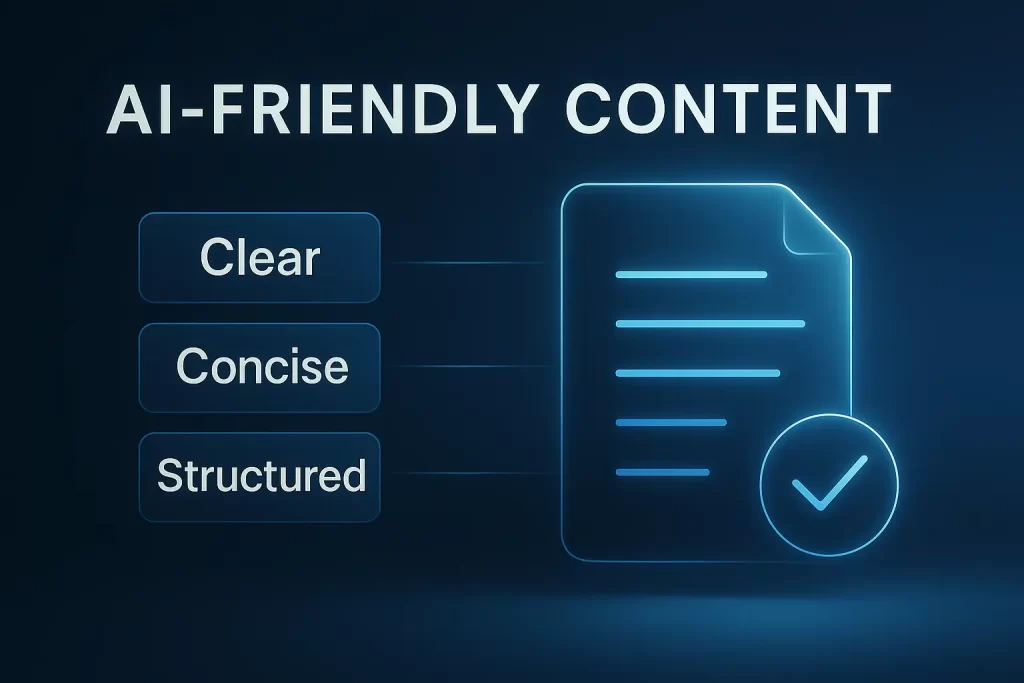
Structure every article using this clarity-first outline.
Here’s how it looks with a real topic like “Content Freshness“.
1. Short Definition (20–40 words)
Content Freshness is a recency signal search engines use to estimate whether a page reflects the latest facts, trends, or data.
It influences visibility for time-sensitive or evolving topics.
2. Summary Bullets
- Impacts rankings most in fast-changing niches (tech, AI, finance, health).
- Can outperform older, higher-authority pages.
- AI systems prioritize up-to-date data over historical accuracy.
- Refresh cycles differ by topic and intent.
3. Analogy or Simple Example
Freshness works like milk on a shelf, the older cartons aren’t bad, but shoppers instinctively grab the newer ones.
Search engines do the same: newer content gets placed up front.
4. Step-by-Step Framework
How to Improve Content Freshness (5 Steps)
- Identify pages losing ranking or traffic.
- Add new data, quotes, stats, examples, or comparisons.
- Update screenshots, tools, links, and step-by-step instructions.
- Expand sections AI often pulls (definitions, FAQs, tables).
- Republish with a new date (only if materially updated).
5. FAQs (Real Example)
No. Google needs substantial updates (new data, rewritten sections).
6. Comparison Table (Real Example)
| Concept | What It Means / When It Matters |
|---|---|
| Content Freshness | Recency of facts/data. Critical for fast-changing niches. Updated every 3–6 months. |
| Content Relevance | Alignment with user intent. Always important. Updated as queries shift. |
| Content Depth | Breadth + detail of coverage. Key for competitive/YMYL topics. Refresh every 6–12 months. |
| Content Velocity | How quickly a brand publishes new content. Vital in news, AI, SaaS. Weekly updates recommended. |
Step 4 - Add Structured Data
Use schema markup for:
- FAQ
- HowTo
- Article
- Review (if relevant)
Schema = a “nutrition label” for AI.
Show JSON-LD Schema Example
<Step 5 - Test in ChatGPT, Perplexity & Google
To accurately test AEO performance, use real AI search environments instead of classic SEO tools. Run the same core queries in ChatGPT, Perplexity, and Google AI Overviews and evaluate:
- If our brand or website is mentioned
- If our content structure or wording is reused
- If competitors are cited instead of us
- If FAQ schema and structured content improve visibility
- If AI engines treat our brand as a trusted entity or ignore it
This gives a real-world signal of whether AI systems understand, trust, and surface our content.
FAQs about AEO (AI Engine Optimization)
There is no exact timeline for AEO results because AI systems don’t work like traditional search engines.
In most cases, early AI mentions can appear within a few weeks, but consistent visibility usually takes 3–6 months or more.
The timing depends heavily on brand authority, content quality, entity clarity, and how often AI systems retrain their models. AEO increases your chances of being cited, but no one can guarantee when it will happen.